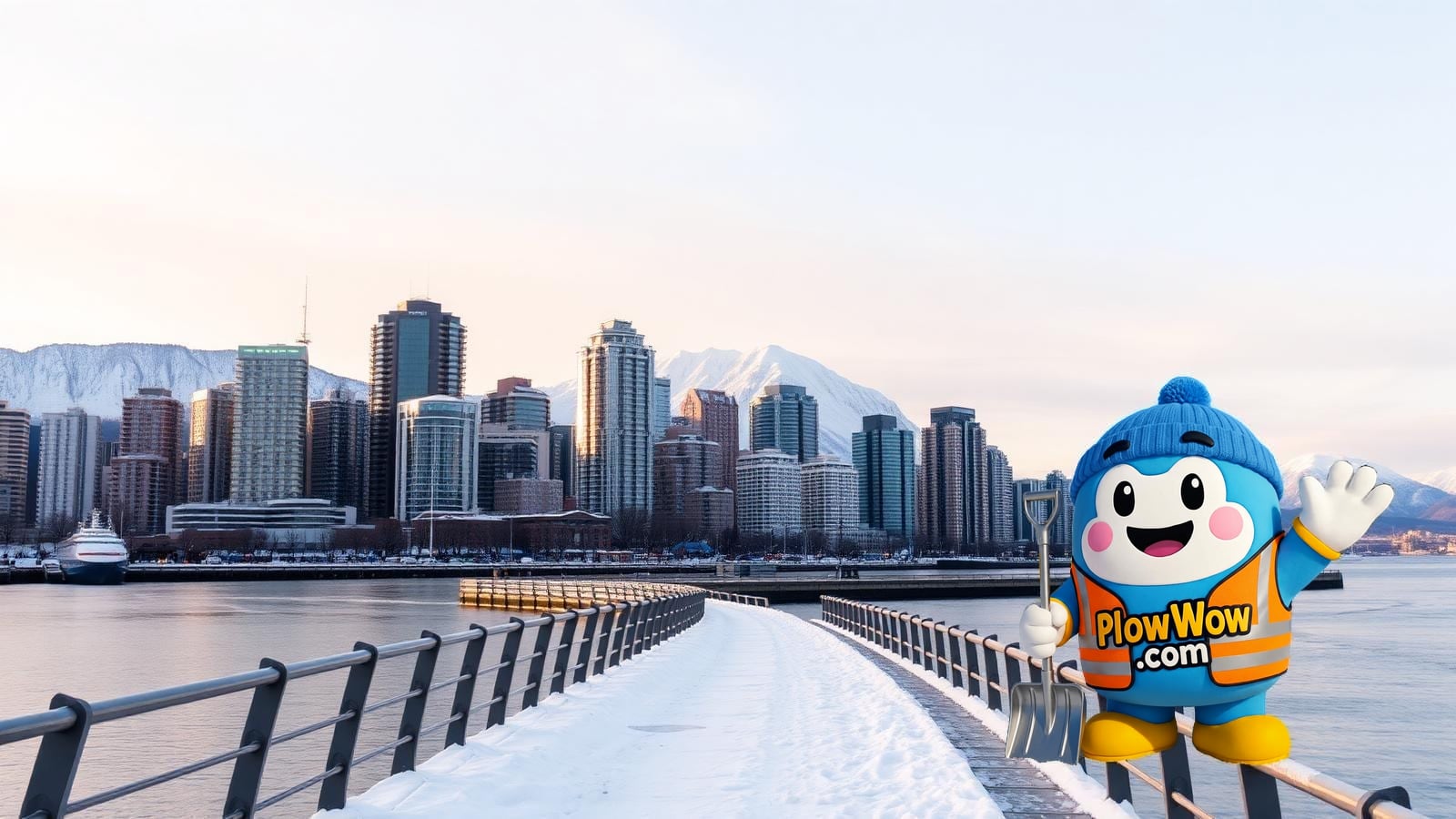
Yes — it snows in Vancouver. Not as often as Toronto or Calgary, and rarely for weeks at a time, but every winter Metro Vancouver gets at least one accumulating snow event, and roughly one winter in four delivers a multi-day storm that shuts down transit, ices sidewalks for a week, and generates thousands of slip-and-fall claims. If you own or manage property in Greater Vancouver, "we don't really get snow here" is the most expensive assumption you can make.
How Much Snow Does Vancouver Actually Get?
According to Environment and Climate Change Canada's climate normals for Vancouver International Airport (YVR), the city averages roughly 38 cm of snow per year, spread across about 10 snow-days. That's the coastal, sea-level average — and it's misleading in three important ways:
- The North Shore gets 2–4× more. North Vancouver, West Vancouver, and any address above 150 m elevation regularly clear over 100 cm per season.
- Burnaby, Coquitlam and the Tri-Cities get 1.5–2× more. Capitol Hill, Burnaby Mountain, Burke Mountain, Heritage Mountain, and Westwood Plateau all sit in a colder microclimate than downtown Vancouver.
- The average hides the outliers. Winters like 2016–17, 2021–22 and 2008–09 delivered 60–100 cm in a single week to the city floor. One severe winter every 3–5 years is the actual planning baseline.
When Does It Snow in Vancouver?
Vancouver's snow season runs mid-November through mid-March, with the highest probability of an accumulating event between late December and mid-February. Specific patterns to know:
- Arctic outflow events. When a cold high-pressure system settles over the BC interior, freezing air spills down the Fraser Valley and through the Sea-to-Sky corridor. These events are cold, dry and windy — perfect for snow accumulation and drift-loading on parkade ramps.
- Pineapple express flip. A Pacific atmospheric river arriving on the back of an arctic outflow produces the most dangerous Vancouver weather: rain falling on a frozen surface. Every major freezing-rain event in Vancouver history has followed this pattern.
- Overnight sub-zero, daytime melt. The classic Vancouver freeze-thaw cycle. Snow falls at 11 p.m., melts to 3 cm of slush by 2 p.m., refreezes to a sheet of ice by 6 p.m. This is when most slip-and-falls happen.
Vancouver's Worst Winters On Record
For property owners, the memory that matters is not the average — it's the outlier. Recent examples:
- 2021–22: A late-December Arctic outflow dumped 40+ cm on Vancouver over 72 hours, followed by two weeks of sub-zero temperatures. TransLink partially suspended service. Insurance industry sources reported record slip-and-fall claim volumes.
- 2016–17: The "snowiest Vancouver winter since 1996." Over 65 cm at YVR across the season, with a 20 cm single event in early February. Roof-collapse warnings issued for older commercial buildings.
- 2008–09: 100+ cm across the season at YVR. Multi-week snow cover, dozens of strata corporations hit with liability claims from unshovelled walkways.
- 1996–97: The reference winter. 65 cm in a single 48-hour December storm. Vancouver was effectively immobilized for a week.
The pattern: a severe Vancouver winter arrives every 3–5 years. Planning for the average and getting caught by the outlier is the single most common property-management mistake in the Lower Mainland.
What Vancouver Snow Actually Does to Property
Vancouver snow behaves differently than prairie snow. Two key characteristics:
- It's wet and heavy. Coastal snow has 2–3× the water content of Calgary or Winnipeg snow. That means heavier shovel loads, faster ice formation on refreeze, and — for older commercial buildings — real roof-load stress after a 20+ cm event.
- It transitions fast. A Vancouver snow event routinely flips to rain, then to freezing rain, then back to snow, within a single 24-hour window. The freeze-thaw cycle is what generates the slip-and-fall claims, not the snowfall itself.
That combination is why Vancouver salt-application volumes per snow-cm are typically higher than in colder Canadian cities — the freeze-thaw window makes reapplication mandatory.
Legal Responsibilities for Vancouver Property Owners
The City of Vancouver Street and Traffic By-law requires the owner or occupier of every property to clear snow and ice from the public sidewalks adjacent to their property by 10 a.m. the day after a snowfall. Every neighbouring municipality (Burnaby, Richmond, North Vancouver, West Vancouver, Coquitlam, Surrey, New Westminster, Port Moody, Port Coquitlam) has a functionally identical by-law with a similar deadline.
For strata corporations, that obligation extends across all common-property walkways, parkade ramps, visitor stalls and fire lanes. For commercial property owners it covers your entire parking lot, every storefront sidewalk, every loading bay and every accessible-parking aisle. Failure to clear is a bylaw-ticket exposure; the far bigger risk is occupier's liability for a slip-and-fall injury, which in BC courts routinely produces six-figure settlements.
How Property Owners Should Prepare — The PlowWow Checklist
If you own or manage property anywhere in Greater Vancouver, this is the pre-season checklist to run every October:
- Contract before the first flake. Contracted snow-removal capacity in Metro Vancouver fills by mid-October every year. Ad-hoc "call us when it snows" is not a strategy — during a real event, every unsigned property is at the back of the queue.
- Get on a seasonal package, not per-visit. Vancouver's freeze-thaw cycle means one storm can trigger 6–10 service passes. A fixed seasonal contract turns unpredictable per-visit invoices into one budgeted line item.
- Confirm pet-safe de-icer. Rock salt burns paws and damages landscaping. Every Vancouver contract should default to pet-safe granules on pedestrian surfaces.
- Verify insurance. Your snow-removal vendor should carry $5M commercial general liability and be in good standing with WorkSafeBC. Ask for proof before signing.
- Map your ramps and stairs. Below-grade parkade ramps and exterior stair sets are the two highest-risk surfaces on any Vancouver property. Both need pre-treatment before forecast events, not just post-storm response.
- Set an automatic dispatch trigger. The best snow contracts don't require you to call. Dispatch triggers at a defined snow depth (typically 2 cm) so service starts overnight, before your morning commute.
- Plan for freezing rain. A dedicated salt-only dispatch — separate from plow dispatch — is what protects you during the Vancouver freeze-thaw window. Confirm your contract includes it.
- Ask about snow relocation. On dense-city properties (West End, Yaletown, Coal Harbour, downtown), curbside snow storage runs out fast. Confirm the vendor can truck snow off-site if needed.
Frequently Asked Questions About Vancouver Snow
Does it snow in Vancouver every year?
Yes. Vancouver has recorded at least one accumulating snow event in every winter for the last 50+ years. The question is not "if" but "how much" and "when".
How much snow does Vancouver get in a normal year?
About 38 cm per year at sea level (YVR), spread across roughly 10 snow-days. North Shore, Burnaby Mountain, and Tri-Cities addresses get 1.5–4× more.
When was the worst snowstorm in Vancouver history?
The December 1996 storm — 65 cm in 48 hours — is the modern reference event. The 2008–09, 2016–17 and 2021–22 winters are the more recent severe seasons.
Do I legally have to clear my sidewalk in Vancouver?
Yes. The City of Vancouver Street and Traffic By-law requires you to clear the public sidewalk adjacent to your property by 10 a.m. the day after a snowfall. Every Metro Vancouver municipality has a similar by-law.
What's the biggest weather risk for Vancouver property owners?
Freezing rain and the freeze-thaw cycle, not the snowfall itself. Vancouver's coastal climate flips between sub-zero and above-zero temperatures within 24-hour windows, generating sheet-ice conditions on sidewalks, ramps and stairs.
When should I sign a snow-removal contract for a Vancouver property?
By mid-October. Contracted capacity fills every year before the first flake, and unsigned properties get de-prioritized during real events.
Does PlowWow service my Vancouver neighborhood?
Yes — every Vancouver neighborhood, plus Burnaby, Richmond, North Vancouver, West Vancouver, Coquitlam, Port Coquitlam, Port Moody, New Westminster, Surrey, White Rock, Delta, Langley, Maple Ridge, Pitt Meadows, Mission, Abbotsford and Chilliwack.
What's the fastest way to get a Vancouver snow-removal quote?
Email Wow@PlowWow.com with your address and property type, or call 604-761-1518. A seasonal quote comes back within one business day.
Book Your Vancouver Snow Removal Before The Season
Vancouver winter weather is unpredictable in its timing but predictable in its consequences: every 3–5 years, an outlier event hits, and every property without a signed contract pays for it — in bylaw tickets, in slip-and-fall claims, in tenant complaints, or in emergency-rate invoices that dwarf a seasonal package.
Get in touch before the first flake:
- Call 604-761-1518
- Email Wow@PlowWow.com
- Or request a quote at plowwow.com
Fixed seasonal pricing. Priority dispatch. Real humans on the phone during every winter event. That is the Vancouver snow-removal contract PlowWow signs with hundreds of Greater Vancouver strata, commercial and residential properties every winter.