Vancouver Strata Snow Equipment: From Sidewalks to Parking Stalls
By the PlowWow editorial team · October 4, 2026 · Winter 2026–2027 planning guide
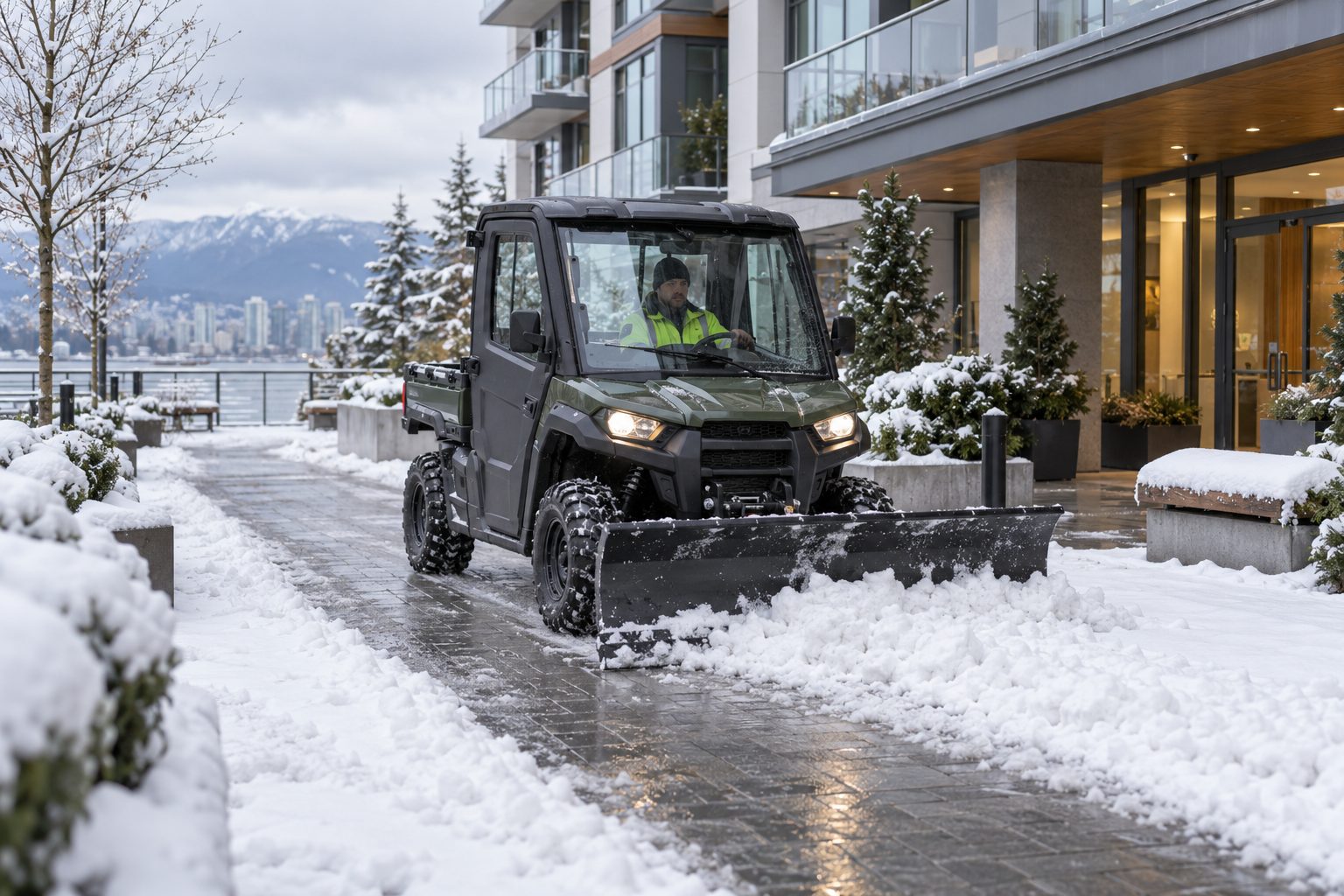
Visual: AI-generated editorial illustration created for PlowWow. A broad private promenade demonstrates why usable width matters; this is not a photograph of a client property or confirmed equipment assignment.
Which equipment fits this property?
For a constrained Vancouver strata, match equipment to each surface: an approved ATV or UTV may suit a broad walkway, a truck may suit an open drive aisle, and compact equipment may suit accessible stall rows. A loader is useful only where access and snow relocation justify it. Full-stall clearing also needs vehicle moves and a snow-storage or hauling plan.
A Vancouver strata can have a long sidewalk frontage, a small rear parking court and almost nowhere to store snow. Choosing the largest plow first misses the real problem: each surface needs a workable clearing route and a destination for the snow. For winter 2026–2027, start with the building layout and the hours people need access.
The useful comparison is not simply ATV versus truck versus loader. It is which machine can reach each work zone, protect its surface and move snow without blocking the next part of the property. A mixed equipment plan may make more sense than one machine attempting everything.
When an ATV or UTV belongs on the sidewalk plan
A wide, continuous private walkway may suit a suitably equipped ATV or UTV. BOSS describes this equipment category for sidewalk snow and ice work. That does not mean every public sidewalk or courtyard allows a vehicle. Confirm permission, pavement suitability and the manufacturer's approved vehicle, mount and attachment combination before assigning it.
Measure the narrowest usable gap between trees, railings, bollards and planters. Include the working blade width, turns and the space needed to deposit snow. A route can be wide for most of its length and still be inaccessible at one entrance. Steps, delicate paving and narrow door approaches need a separate hand-clearing or appropriately sized walk-behind plan.
For a commercial frontage near Mount Pleasant or a dense strata in the West End, the pedestrian route may be the main job rather than a small extra on a parking-lot contract. Record curb ramps and the connection from accessible parking to the entrance, not just a strip down the middle of the sidewalk.
Where a plow truck fits—and where it runs out of room
A truck-mounted plow is worth considering for accessible drive aisles and open ground-level parking areas with enough turning and snow-storage space. Tight rear courts, overhead obstructions and parked vehicles can limit what it can reach. Ask the contractor to show its proposed travel and discharge direction on a site plan.
A plow pushes snow somewhere else on the property; it does not make that volume disappear. A low initial price can become a poor comparison if one proposal includes relocation while another leaves a pile occupying visitor stalls. Use the same storage assumptions when comparing quotes.
Does clearing every stall require a front-end loader?
Not automatically. A compact loader or skid steer with an appropriate attachment may work in a constrained parking court where a larger loader cannot manoeuvre. A front-end loader may help relocate accumulated snow or load a haul truck where access and capacity support it. Neither can clear beneath parked cars.
Arrange a staged vehicle-moving window before promising full-stall service: open the travel aisle, move one agreed group of vehicles to a cleared holding area, clear the vacant stalls, then repeat. Keep people away from operating equipment and preserve an accessible route throughout. Include wheel stops, curb edges and drains in the pre-season survey so the operator is not discovering them under snow.
Avoid an undefined promise to clear “every inch.” Specify which accessible surfaces are included, what remains blocked by vehicles or fixtures, and how missed stalls receive a return visit. Mechanical clearing also needs a separate ice-control and inspection plan; exposed pavement is not a guarantee that it will stay ice-free.
Decide when storage becomes hauling
Mark a storage area that does not obstruct doors, fire access, sightlines, accessible stalls or drainage. On a small urban site, that area may fill before the rest of the service problem is solved. Agree who can authorize relocation or off-site hauling, how it is priced, and where snow may lawfully be taken. A loader alone is not a disposal plan.
Vancouver's winter maintenance guidance requires owners and occupants to clear snow and ice from sidewalks around their property by 10 a.m. each day. Put the relevant frontage into the schedule and confirm the current municipal requirements before the season; a parking-lot trigger is not a substitute for sidewalk obligations.
Send a useful Vancouver quote request
Include photos, the narrowest access measurements, frontage length, parking layout, operating hours, proposed storage and the vehicle-moving contact. Ask for separate scope covering pedestrian clearing, vehicle areas, stall cleanup, ongoing ice monitoring and any hauling.
Review our Vancouver snow-service planning and sidewalk clearing guide, then send your property details. Equipment, route placement and service availability must be confirmed for the actual site. For a different layout, see the Burnaby slope and parkade guide.
Frequently Asked Questions
Is a UTV the best option for a wide Vancouver sidewalk?
It can be suitable if the full machine and blade fit the route, the surface permits its weight and use, and vehicle access is authorized. Narrow gates, stairs, delicate paving and entrance details may require smaller equipment or hand clearing.
Can a loader clear every parking stall without moving cars?
No. Vehicles must be moved out of the work zone. A phased plan should identify a holding area, the order of stall groups, protected fixtures and any follow-up for blocked spaces.
When should a small strata consider snow hauling?
Consider hauling when approved on-site storage cannot hold the snow without blocking required parking, access, sightlines or drainage. Agree on loading, transport, lawful disposal and authorization before the storage area fills.