

News flashback · Historical event: January 2024 · Published October 29, 2026. Original retrospective planning, not a current weather warning or forecast.
A historical cold outbreak is not today’s service forecast
ECCC’s retrospective identifies the mid-January 2024 Arctic outbreak as a major western-Canada weather event. It describes regional cold and its impacts; it is not a service log for an Abbotsford business. This feature gives no unverified local snowfall total, customer outcome or crew response. Its original analysis asks how a commercial or shared property can make winter access and snow storage understandable before it accepts a service plan.
The phrase polar vortex belongs to a broader atmospheric discussion. NOAA distinguishes the high-altitude circulation from cold air at the surface, and this article does not claim a proven vortex cause for a specific Abbotsford incident. The event date is January 2024; the article’s preparation date is October 2026. Keep both visible when sharing it. A retrospective should help a reader examine a present plan without suggesting that old weather is happening again or that the next event has already been forecast.
The short answer for a working property
Define the space that needs to remain usable, identify where displaced snow can be placed and decide who may approve changes as conditions evolve. A parking-area measurement is only one part of that brief. Loading access, staff arrival, shared pedestrian routes and storage can compete for the same space. A proposal becomes more useful when it shows these relationships instead of treating the property as a single blank rectangle.
Start with the actual Abbotsford address and property boundary. Keep public-road maintenance separate from private work and verify current municipal information for the site. The City publishes snow and ice priorities and describes responsibilities for bordering sidewalks and footpaths. Read the official guidance and applicable requirements directly; this article does not certify compliance. A municipal operation outside the site does not mean a private lot, loading area or entrance has been cleared, and a private quote does not establish a public-road response time.
Build the brief around the daily operation
Ask what the property needs to do during ordinary working hours. Where do staff arrive, where do visitors park and where do deliveries stop? Which spaces can temporarily change use, and which require a separate decision? These are business questions the owner can answer without pretending to predict the weather. They give the service reviewer a better starting point than a total area with no explanation of how the site operates.
For a conceptual example, imagine a small warehouse with a public-facing office entrance and a delivery door on another side. The shared pedestrian approach and the vehicle movement area may need different methods and coordination. If both are requested, name both. If one is excluded, make that exclusion clear. This is not an actual Abbotsford customer or completed project. It illustrates how one address can contain several distinct work areas whose boundaries need to survive beyond the first conversation.

Original PlowWow editorial diagram. Planning sequence, not a site record or technical instruction.
Give snow storage the same attention as clearing
A proposal should identify where displaced snow may be stored, subject to an actual property review. Show the proposed locations on a sketch and explain other uses of those spaces. The responsible people need to consider entrances, movement, visibility and any site features that affect suitability. This guide does not approve a pile location or authorise moving snow onto a public road, neighbouring property or another unsuitable area.
Storage should not be treated as a leftover question after every convenient space has been assigned to parking or deliveries. Ask the reviewer how the proposed arrangement affects the usable area and what happens after repeated work. A storage location that seems sufficient at the first discussion may need reassessment. The useful decision is who can approve a change, not a universal promise that one corner will always be enough. Keep that authority and the accepted location with the current service scope.
Distinguish moving snow on site from hauling it away
Clearing a route, repositioning a pile and off-site relocation are not automatically the same service. If hauling may be considered, discuss it separately and ask what triggers a review. It requires a confirmed scope and current equipment, trucking and related charges. A seasonal clearing description should not silently imply unlimited removal from the property. No price or hauling commitment is established by the illustrations or examples in this feature.
A practical file can contain the preferred storage arrangement, the person authorised to approve an alternative and the contact route for discussing an extra. Keep the instruction current if the business changes how it uses the site. Do not wait until a delivery area is needed to discover that no one knows who may authorise moving a pile. The aim is not to overcomplicate routine work; it is to make an exceptional decision understandable before several people issue conflicting instructions.
Preserve the pedestrian connection through the operation
Trace a shared route from the agreed arrival point to the office or common entrance. Mark any lane crossing, ramp, gate, landing or shared stair. A clear vehicle area is not proof of a continuous pedestrian approach. Likewise, a short cleared walkway may not connect to the place where people actually arrive. Give the route segment names that match the photographs and written proposal so a reviewer can find the same places without relying on memory.
PlowWow’s rough planning includes stairs belonging to the agreed shared walkway. Individual-unit stairs and private unit entrances remain excluded unless specifically agreed. There is no need to count every stair for an initial discussion; identify the shared stair locations and let the actual review establish the work. On a mixed property, keep residential and commercial entrance assumptions separate. A broad promise about the whole site is less useful than a plain description of which common paths are being discussed and what still needs confirmation.
Record the access constraints before selecting equipment
A wide paved area may suggest one method, while a narrow passage or enclosed entrance needs another. Show gates, turning space, parked equipment, overhead restrictions and times when access is limited. Ask the reviewer to confirm a suitable method for the actual site. This article does not determine whether a truck, compact machine or other tool can safely operate in a particular location.
Do not let equipment imagery substitute for an agreement. The established Wow mascot and the winter scenes on this page are editorial brand illustrations, not evidence of a machine assigned to an Abbotsford property. If dedicated equipment, special access or an additional labour arrangement is important, put it into the confirmed scope. A neighbouring site’s arrangement should not be assumed to apply. The best first brief gives the reviewer enough information to explain the method and its limits without turning a generic picture into a promise.
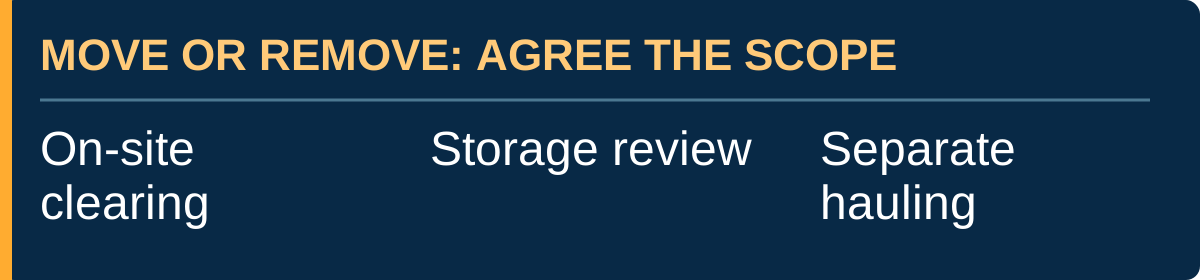
Original PlowWow editorial diagram. Planning sequence, not a site record or technical instruction.
Keep treatment-only work on its own line
A property may need to discuss treatment-only visits separately from full clearing. Identify the surfaces under consideration and how the selected material and visit are recorded. Do not use the historic cold outbreak to infer a universal dose or material choice. Actual conditions, surface suitability, material instructions and an appropriate application method matter. This retrospective supplies no application prescription or guarantee that a product works in every circumstance.
Tell the reviewer about sensitive surfaces or requested alternatives before accepting a price. A different material may change cost and handling. Ask what the final description means in practical terms rather than relying on an environmental label or a photograph of a salter. Equally, keep observed site conditions separate from a weather-application screenshot. The record should help the responsible people understand the decision that was made, not imply that a single air-temperature reading describes every part of a commercial property.
Make the public-to-private boundary visible
Abbotsford’s current snow and ice information explains that road work follows priorities and that private owners have their own responsibilities. Use the current official page for the complete framework. Do not infer that a road’s importance creates an exact completion time for a private entrance or that a public plow will clear the site’s frontage obligation. These are separate questions requiring the appropriate authority or agreement.
For the private brief, list the public approach, bordering pedestrian area, vehicle entrance and internal shared route as distinct locations. Assign only the responsibilities that have actually been confirmed. If a municipal pass later affects the entrance, ask how private follow-up is handled under the agreement. Do not assume an automatic additional visit or charge without reading the scope. A four-column table—location, requested work, responsible party and confirmation status—can expose a missing answer without pretending the article itself supplies it.
Prepare staff communication without creating false certainty
Choose a primary property contact and a backup who can access the current plan. Staff need a concise explanation of the agreed route, reporting method and any operational change. Avoid a promise that every parking stall or delivery door will be ready at a precise time unless the actual arrangement supports it. Differentiate a requested visit, an acknowledgement, attendance and a confirmed outcome in the language used for updates.
A report should identify the location and observed condition rather than guessing why it happened. Use photographs when relevant, protect personal information and avoid publishing private access details. A resident or employee message is not automatically an approved contractor work order. Explain who reviews the message and who can authorise a change. Clear communication does not remove weather uncertainty, but it makes the next decision easier to follow and gives a backup a usable record if the usual contact is unavailable.

Original PlowWow editorial diagram. Planning sequence, not a site record or technical instruction.
Compare proposals on the work behind the total
Put the written scopes side by side before comparing only prices. Mark differences in storage, shared walkways, treatment-only provisions, return visits and unusual access. Ask how heavy events, repeated work or a dedicated-equipment commitment are handled. A proposal that includes the delivery approach is not directly comparable to one that covers only the visitor parking area. The purpose of a review is to resolve those differences, not to force every property into a single package.
The PlowWow address estimate can start that conversation. Supply the actual Abbotsford address and the areas you want reviewed. An initial figure does not prove that the property has been inspected, the scope accepted or a crew reserved. Keep assumptions attached to the number, including what needs an on-site review. A useful starting estimate gives an owner enough context to decide whether to continue, while the final agreement explains the work and terms that are actually being accepted.
Use documentation for clarity, not a guarantee
Keep the accepted scope, current route sketch, contact list and relevant service records together. Give each version a date and make it clear which one is current. A later photograph can support a factual review, but it does not demonstrate every condition at a property or establish a legal conclusion by itself. Record what is known and leave uncertainty visible rather than adding a confident claim that the evidence cannot support.
PlowWow does not promise insurance discounts, liability protection or dispute resolution from a timestamp or image. Those outcomes depend on the actual circumstances and arrangements. Snow Intelligence remains first-year beta, and this feature announces no verified automated forecast, dispatch or booking capability. The practical value of a record is that another authorised person can understand the work, identify the next question and find the right contact. That is worthwhile without converting operational discipline into an unsupported financial or legal promise.
Turn the flashback into one concrete improvement
Before the next actual event, ask a backup to read the plan and identify the entrance, shared route and snow-storage decision. If they cannot do it without calling the original organiser, improve the wording or sketch. Check that the backup knows which extras require approval and where the accepted contact details are kept. This is a desk review, not a test service request or a claim that a crew has attended.
Keep the January 2024 event date separate from this October 2026 feature and from any real visit record. The new Wow scene is an imagined commercial setting, not historical footage or a customer photograph. For current weather, consult official forecasts and warnings. For an actual Abbotsford property review, call PlowWow at 604-761-1518 or email wow@plowwow.com. Explain the operation, access and requested work, then confirm availability and terms directly. The strongest lesson is to plan where the snow goes while planning what the property needs to keep doing.
Sources, dates and related planning
Historical event: January 2024. Publication: October 29, 2026. Primary sources were checked for this retrospective; municipal guidance describes the current published framework rather than proving a January 2024 response at any property.
- ECCC — Canada's 2024 impactful weather stories, including the January Arctic outbreak.
- NOAA/NWS — what the polar vortex is.
- Abbotsford — official snow and ice information.
- Abbotsford service-planning context.
- Current Snow Intelligence beta status.
- The separate Langley City and Township planning guide.
Hero and share artwork: original AI-assisted PlowWow editorial illustrations using the approved established Wow character. Imagined scenes, not archive footage, customer photographs or completed-work evidence. Narrow planning graphics: original PlowWow editorial artwork.