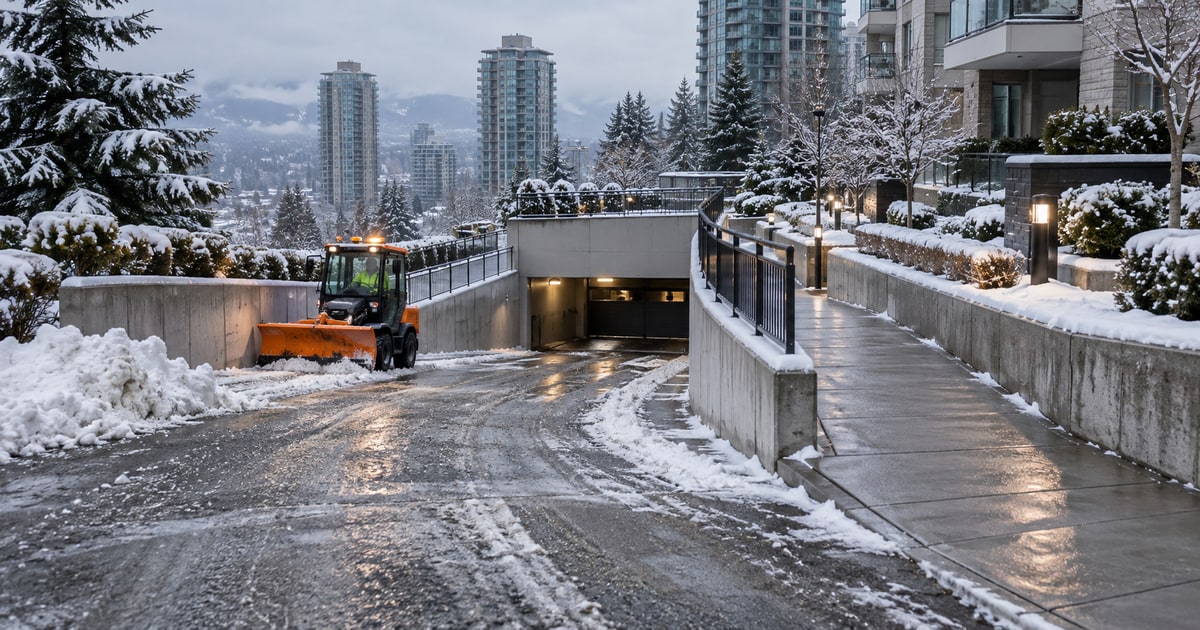
Burnaby snow and ice planning has to account for elevation, slope and drainage. A property near Burnaby Mountain can experience different surface conditions from a site near Big Bend, while a steep parkade ramp may freeze before the surrounding road. For strata councils and commercial managers, these differences should be mapped before the storm rather than discovered during an emergency call.
This guide supports our main Burnaby snow removal service page with a focused plan for hills, parkade ramps, pedestrian routes and refreeze control.
Burnaby's 10 a.m. Sidewalk Rule
The City of Burnaby's guidance for residents and businesses says owners or occupiers of single-family, two-family, multi-family, industrial, commercial and institutional properties must remove snow or ice from surrounding sidewalks no later than 10 a.m. every day, including holidays.
The official City page should be checked for current requirements. From a service-planning perspective, the important point is that a Burnaby property may need its public sidewalks completed while crews are also managing private ramps, internal walkways and vehicle access.
Map Elevation and Grade Before Winter
A useful Burnaby site plan identifies more than square footage. It should record where gravity moves water and where vehicles or pedestrians lose traction.
Mark these areas on the pre-season map:
- Public sidewalks along every frontage
- Parkade entrances and the bottom transition of each ramp
- Sloped drive aisles, loading approaches and garage aprons
- Accessible entrances and curb ramps
- Exterior stairs, landings and raised walkways
- Catch basins, trench drains and low points
- Shaded north-facing surfaces
- Approved snow-storage areas and prohibited pile zones
This map becomes the basis for a repeatable service route. It also allows the quote to separate machine-clearing areas, hand-work areas and ice-control zones.
Treat the Parkade Ramp as Its Own Service Zone
A parkade ramp is not just another driveway. It may combine polished or painted concrete, a change in grade, overhead cover, trench drainage and vehicle traffic that compresses slush.
A written ramp plan should answer:
- Where will the ramp be closed or controlled while work is underway?
- Can the equipment safely operate within height, width and turning limits?
- Where can snow be moved without blocking the ramp or drain?
- Which ice-control product is approved for the surface?
- Does the bottom transition collect meltwater?
- When is a return refreeze check required?
For a multi-unit site, connect this ramp plan to the broader strata snow-removal scope. Retail, office and industrial managers can also review commercial snow clearing.
Separate Pedestrian and Vehicle Priorities
Vehicle access and pedestrian safety require different equipment and timing. A compact plow may open a drive aisle, but it cannot detail a stair landing or the narrow approach to an accessible entrance.
A practical first pass normally opens:
- A continuous pedestrian route from the public sidewalk to the main entrance
- Accessible paths and curb transitions
- Emergency exits and fire-service access
- The parkade or loading route identified as operationally critical
Once those routes are open, crews can widen the service area, finish secondary paths and move snow into the approved storage zones.
Control Meltwater Before It Refreezes
Burnaby's hills make drainage visible. Water travels down a ramp or walkway and can freeze at the bottom, particularly when a drain is covered or the surface loses heat overnight.
The snow plan should keep piles away from catch basins and trench drains. After clearing, inspect the downhill edge of each service zone for:
- Runoff crossing a walkway
- Water collecting at the bottom of a ramp
- Roof or canopy drip landing near an entrance
- Slush pushed into a shaded low spot
- A drain blocked by leaves, snow or compacted ice
Ice control works best as part of this drainage plan. Applying more material does not correct a blocked drain or poorly placed snow pile.
Use the Right Level of Ice Control
Salting and de-icing should be defined by surface and condition. A quote should state which zones can be treated, which product is expected and whether the material is included or billed separately.
Property managers should also identify sensitive finishes, landscaping, pet areas and building rules before work begins. The goal is a controlled application that supports traction and serviceability, not an undefined promise to spread product everywhere.
If the property needs documented dispatch and repeat-visit coordination, review the PlowWow snow-removal management system.
Plan Snow Storage for a Dense Burnaby Site
Modern Burnaby developments may have limited ground-level space. A small pile that works during the first snowfall can block visibility, parking, drainage or pedestrian access after another pass.
The plan should rank storage locations and set a point at which snow relocation or hauling must be quoted. Never assume the street, bike lane, neighbouring property or public sidewalk is an acceptable storage location.
For landscaped strata sites, also mark walls, curbs, planters, irrigation heads and low fixtures before they disappear under snow. That simple map reduces avoidable damage and gives operators a clear edge for machine work.
Build the Contract Around the Actual Burnaby Property
A strong scope lists the work rather than relying on broad phrases such as “full service.” It should describe:
- The measured sidewalks, ramps, stairs and parking surfaces
- Service triggers and who authorizes dispatch
- Priority areas for the first pass
- Hand work versus machine work
- Salting or de-icing zones and product charges
- Return checks for refreeze or additional accumulation
- Snow-storage limits and relocation approval
- Access instructions, gate codes and parking restrictions
- The service record provided after each visit
Burnaby neighbourhoods also need different emphasis. Capitol Hill, Forest Grove and Burnaby Mountain properties may prioritize grade and elevation. Metrotown, Brentwood and Lougheed sites may combine high pedestrian traffic with ramps and limited snow storage. Edmonds, Highgate and South Burnaby properties can still have steep access, shaded walkways and drainage trouble even at lower elevations.
Keep Records That Help Improve the Route
A useful service record can note the visit time, observed conditions, areas cleared, zones treated, product used and hazards reported. Photos should show the service route while respecting resident and tenant privacy.
The purpose is operational clarity. If the bottom of one ramp refreezes after every storm, the next plan can add a targeted return check instead of repeating the same problem.
Frequently Asked Questions
When must Burnaby sidewalks be cleared after snow?
The City of Burnaby says owners or occupiers must remove snow or ice from surrounding sidewalks no later than 10 a.m. every day, including holidays. Confirm the current wording on the City's official snow-and-ice page.
Why do Burnaby parkade ramps need separate planning?
Ramps combine grade, drainage, vehicle compaction and surface-specific product requirements. The bottom transition can refreeze even when the upper ramp appears clear.
Is salting automatically included with snow clearing?
Only when the quote says so. The scope should identify treatment zones, triggers, approved product and whether material is included or billed separately.
What information is needed for a Burnaby strata snow quote?
Provide the sidewalk frontage, internal walkways, stairs, ramps, parking or drive areas, service priorities, drainage points, snow-storage limits and any surface or access restrictions. Photos and a marked site plan help produce a more accurate scope.
Request a Burnaby Site Plan
Call 604-761-1518 or use the PlowWow quote form for pricing based on the property's actual grades, pedestrian routes, drains and snow-storage limits. A measured plan is more useful than a generic per-property promise.