Metrotown & South Burnaby
Strata entrances, parkade ramps, retail walks and busy parking access.
Planned winter service for strata, commercial and residential properties in Metrotown, Brentwood, Burnaby Mountain, Capitol Hill, Edmonds and Lougheed. Plowing, walkway clearing and de-icing from one local team.
Burnaby local guides
Burnaby combines steep residential streets, dense high-rise districts, parkade ramps and large commercial or industrial properties. We separate the site into vehicle and pedestrian work, choose equipment for the available space, and set the clearing order before crews arrive.
Strata entrances, parkade ramps, retail walks and busy parking access.
High-density residential, office entrances and mixed-use properties.
Townhouse access, commercial sites, sidewalks and sloped approaches.
Elevation, grade and refreeze risks that need planned treatment.
Drive aisles, walks, stairs, ramps and entrances grouped into a clear, repeatable site plan.
Customer and staff access, parking lanes and loading areas sequenced around operations.
Booked driveway and walkway work quoted for the lot, grade and access.
Local service guides
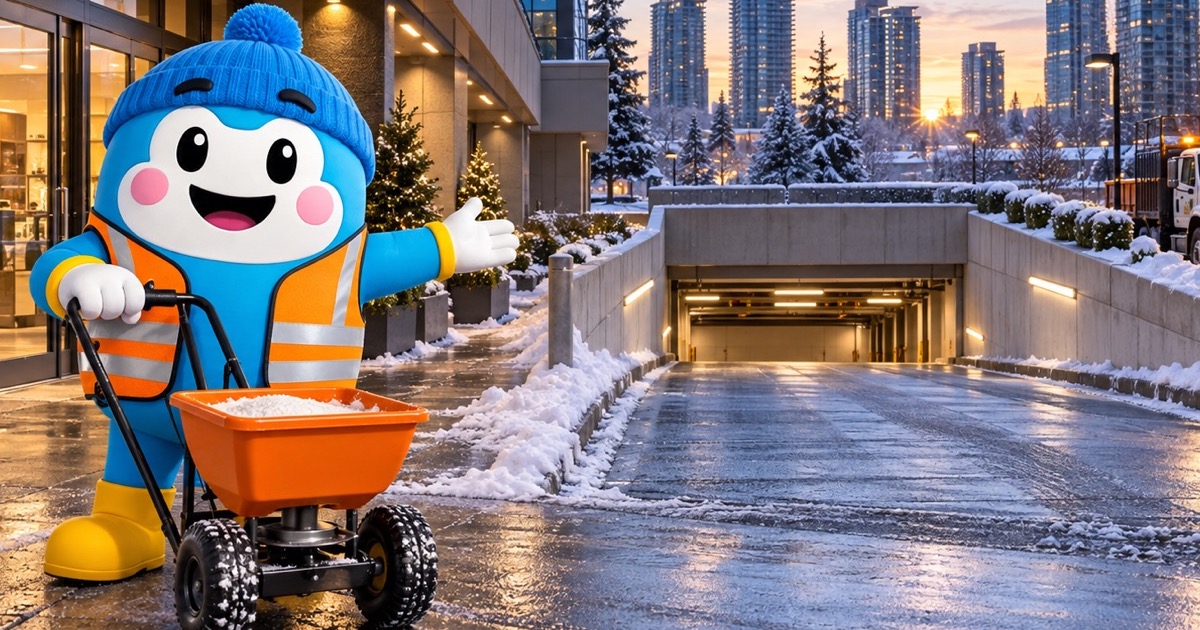
Parkade ramps, hills, entrances, loading access and pre-opening readiness.
Read guide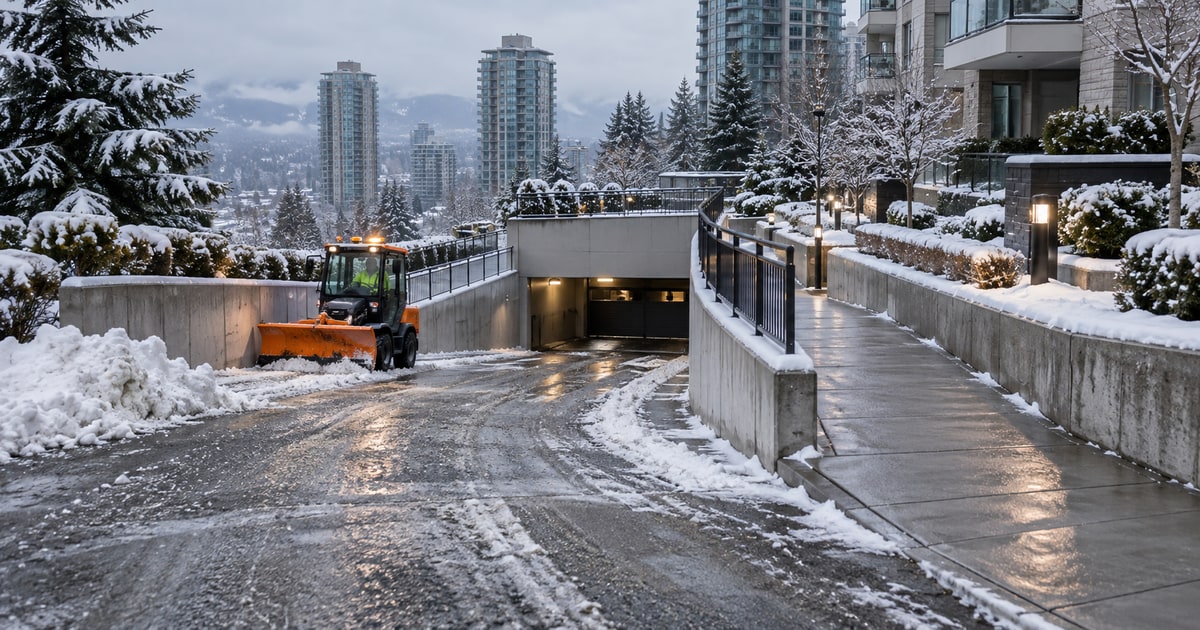
A practical plan for slopes, ramps, drainage and overnight refreeze.
Read guide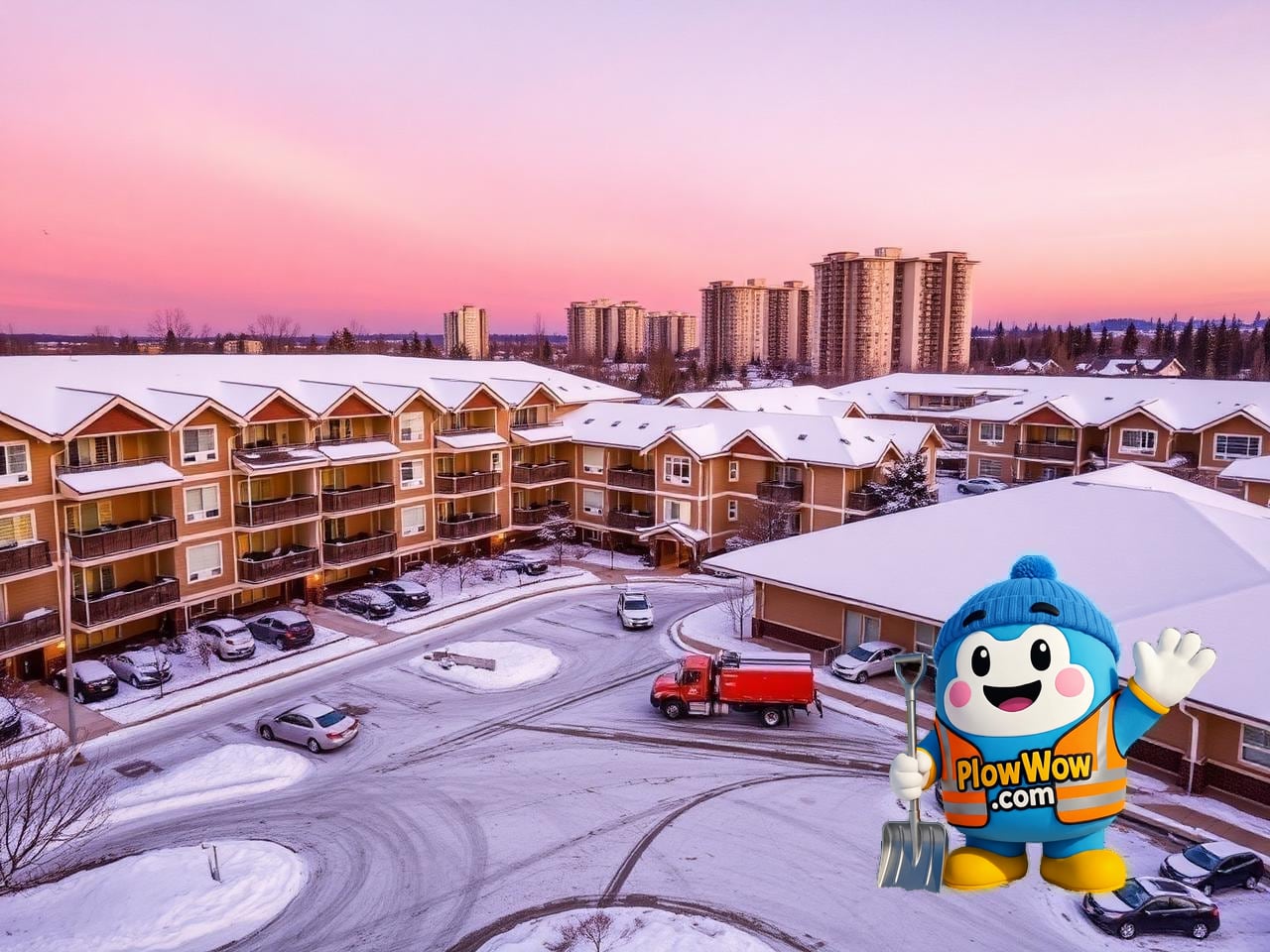
Pedestrian access, parkade approaches and high-density residential sites.
Read guide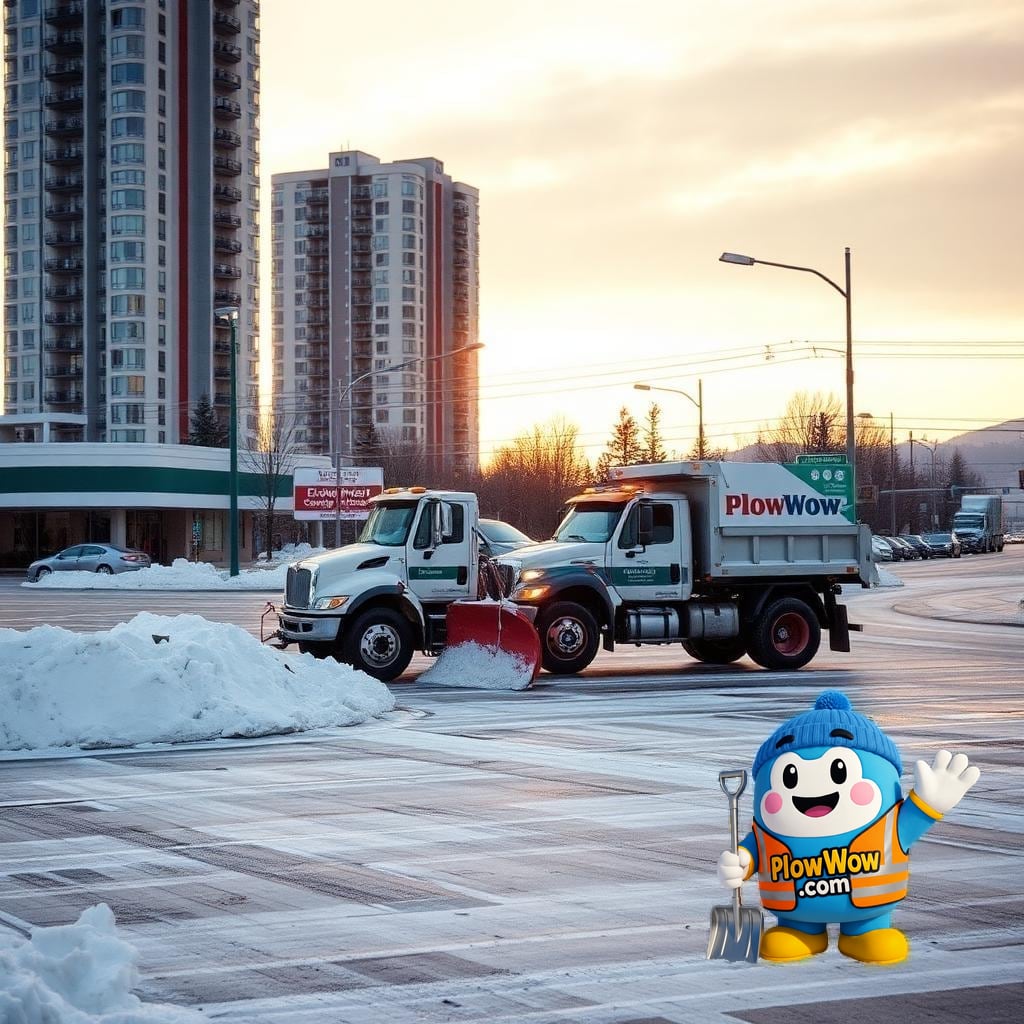
Winter access planning for mixed-use, commercial and residential properties.
Read guideBurnaby winter service
Conditions can differ between Burnaby Mountain, Metrotown and South Burnaby during the same storm. Before winter, we identify your priority surfaces, access limits, snow-storage areas and treatment expectations so crews arrive with the right equipment and a clear scope.
Entrances, walkways, drive lanes and parkade ramps planned around resident access and the property’s service triggers.
Parking areas, loading zones and pedestrian routes cleared around operating hours, site access and documented priorities.
Driveway, steps and walkway service for properties that fit an active Burnaby route, quoted by layout and scope.
Snowfall patterns and service zones for every Burnaby property.
Average accumulation (mm) — Environment Canada normals
Priority dispatch across all six zones — tap a zone to learn more.
Enter a starting address to see the estimated driving distance to Burnaby City Hall, and open turn-by-turn directions in Google Maps.
Open in Google MapsEverything Burnaby residents and property managers need in one place — school alerts, city plow routes, and live conditions.
Burnaby's terrain changes block by block. Our crews and equipment are tuned to each zone.
Challenge: Steep grades, exposed elevation, heavier snowfall
PlowWow Solution: Heavy-equipment plows, traction-grade salt blends, dawn-priority dispatch for university and UniverCity strata.
Challenge: High-density towers, underground parkades, retail foot traffic
PlowWow Solution: Sidewalk crews + skid-steers, accurate salt logs for liability, off-peak snow relocation.
Challenge: Mixed strata + single-family streets with mature trees
PlowWow Solution: Compact equipment for tight lanes, eco-friendly de-icer near landscaping, scheduled morning passes.
Challenge: Wide residential lots, longer driveways
PlowWow Solution: Per-property service plans, seasonal contracts with unlimited visits, GPS-verified arrival times.
Pick the service track that fits your property.
Choose On-Call flexibility, or lock in Seasonal Unlimited before the first storm.
On-Call
Flexible service for properties that only need help during major events.
Request On-Call QuoteSeasonal Unlimited
Priority dispatch, unlimited visits, predictable budgeting — ideal for strata & commercial.
Lock In Seasonal Rate| Feature | On-Call | Seasonal Unlimited |
|---|---|---|
| Priority dispatch | ||
| Unlimited visits Nov–Mar | ||
| Pre-storm salting | ||
| Photo & GPS service log | ||
| Per-visit billing | ||
| Fixed seasonal price |
Answers to what Burnaby residents, strata managers and businesses ask most.
Temperature
…
Conditions
Loading…
Today's snowfall
…
Data via Open-Meteo. Full Burnaby forecast on Environment Canada. PlowWow seasonal-contract clients receive same-day advisories by email or SMS whenever a snowfall or Arctic outflow warning is issued for Burnaby.
View PlowWow Burnaby on Google Maps . Approximate service radius: 30 km from Burnaby centre. Priority landmarks below are the property clusters we dispatch to first during any Fraser Valley snow event.
Snow removal in Burnaby is fundamentally an elevation problem disguised as a weather problem. The city spans from tidewater at Big Bend to 370 metres at the Simon Fraser University campus on Burnaby Mountain, and the freezing level on a typical Metro Vancouver winter storm slices through Burnaby somewhere between 100 and 250 metres. That single geographic fact means a property manager with sites in Metrotown, Brentwood, and University Highlands is not managing one city — they are managing three climates that require different equipment, different products, different response windows, and different insurance postures.
The second thing Burnaby does differently than the rest of Metro Vancouver is density. With more than 950 registered strata corporations packed into 90 km², Burnaby has the highest strata concentration in the region outside downtown Vancouver, and its council culture has grown notably more risk-conscious since 2021 as insurers have tightened deductibles and refused renewals for corporations without documented snow-and-ice programs. Metrotown alone contains dozens of high-rise strata podiums where a single missed 6:00 AM ramp de-ice can trigger a five-figure insurance claim, and the phrase 'reasonable care' under the Occupiers Liability Act has come to mean, in practice, a professional contract with a documented log.
The third defining factor is transit density. Burnaby is served by both the Millennium Line and the Expo Line, plus the R5 Rapid Bus to SFU, the 144 mountain shuttle, and the 130 Willingdon workhorse. TransLink station approaches, bus stops, and Rapid Bus platforms all have de facto pedestrian-load standards that far exceed what a strata sidewalk sees on a normal weekday morning. A property abutting a Millennium Line station entrance is not being asked to clear a sidewalk for its residents — it is being asked to clear it for 30,000 commuter boardings a day, and the courts have begun to reflect that in duty-of-care rulings.
The fourth factor is commercial complexity. The Metrotown and Brentwood retail engines run on 5:00 AM readiness windows; the Willingdon and Boundary office towers on 7:00 AM occupancy; Big Bend on 24-hour logistics with no dock closure tolerance. Fitting all three into a single overnight route rotation requires dispatch discipline that a general landscaping contractor simply does not have. Burnaby is where equipment redundancy — spare skid steers, backup salter routes, second-truck coverage — either shows up or gets exposed on the first big storm.
Finally, Burnaby has become a documentation-first city. Under a 2018 amendment cycle to Bylaw No. 5106 and follow-on enforcement guidance, the City has moved to fine assessments up to $2,000 per offence with clearing costs added to the property tax roll for repeat non-compliance. Strata insurers, in turn, now request event-level documentation as part of renewal underwriting. PlowWow's Burnaby contracts are built around that reality: every visit is GPS-logged, every product application is recorded, and every incident summary is delivered to the property manager within 24 hours.
Avg annual snowfall: 52 cm · Season: November–March · Freeze-thaw cycles: 24/winter
Burnaby's winter weather is a three-way collision between coastal Pacific moisture, Fraser Valley outflow, and Burnaby Mountain's orographic lift. Coastal storms deliver most of Burnaby's precipitation volume, but at the elevations of Forest Grove, University Highlands, and the SFU campus, that precipitation frequently arrives as heavy wet snow while Metrotown is receiving plain rain from the identical system. Orographic lift on the west and south flanks of Burnaby Mountain can double the snowfall totals recorded at the mountain top compared to the lowland stations that Environment Canada uses for citywide reporting.
The 24 freeze-thaw cycles Burnaby averages each winter are the real operational driver, not the 52 cm headline snowfall number. Each cycle produces black ice at dawn on parking-lot slopes, stair risers, and ramp aprons that were wet at midnight. Black ice cannot be plowed away; it can only be pre-empted with liquid brine or reactive granular de-icer, and the timing of that treatment is the single largest predictor of whether a Burnaby property will finish a winter with zero slip-and-fall claims or with three.
Arctic outflow events add a second overlay. When cold air spills west out of the Fraser Canyon and settles on the valley floor, Burnaby's lowlands cool faster than the coastline while the mountain top holds a persistent inversion. During outflow, Metrotown can be -8°C at 6:00 AM while SFU registers -4°C at the summit and Deer Lake sits somewhere between. These are the events during which sodium chloride stops working and any Burnaby contractor still operating on a rock-salt-only product mix begins to fail visibly.
Rain-on-snow events are Burnaby's insurance-claim generator. When a Pacific system arrives on day three of an outflow — a pattern that repeats roughly six to ten times per winter — rain lands on frozen ground and freezes on contact, producing glaze ice across parking lots, ramps, plazas, and transit platforms. This is the exposure that most under-invested contractors fail to price and that most Burnaby strata councils do not fully understand until they have their first six-figure claim. PlowWow's crews stay on rotation for the entire storm arc, including the tail-end refreeze window, because the visible snow is not the risk — the invisible 3 mm of glaze ice on day three is.
The Burnaby snow season practically begins November 1 and runs through March 31. Cold-air advisories start in the first week of November. The first accumulating event most years lands between November 15 and December 10. Peak accumulation runs from late December through mid-February, and March is the wildcard — Burnaby has recorded 25 cm March events and 18°C March thaws in the same week. Any seasonal contract that begins on December 1 or ends on February 28 is leaving weeks of documented exposure uncovered.
Environment Canada issues Winter Storm Warnings, Snowfall Warnings, and Arctic Outflow Warnings for Metro Vancouver on independent triggers, and PlowWow's operations desk monitors all three continuously from November 1. When a warning affects Burnaby, seasonal-contract clients are notified by 6:00 PM the evening before, brine pre-treatment begins by 10:00 PM at Metrotown parkades and SFU-adjacent driveways, and full crew staging is complete by 3:00 AM on event morning. That timeline is the minimum operational standard for any Burnaby strata, medical, or retail property that wants to be defensible in a slip-and-fall file.
TransLink expects property owners to clear frontages adjacent to bus stops before the first morning trip. Strata and commercial properties along the following Burnaby corridors are prioritised in our dispatch schedule.
Millennium Line
VCC-Clark — Lougheed via Brentwood, Gilmore, Holdom
TransLink
Expo Line
Metrotown — Edmonds — 22nd Street
TransLink
R5 Rapid Bus
Hastings — SFU
TransLink
144
Metrotown — SFU (winter chain-up dependent)
TransLink
130
Metrotown — Kootenay Loop via Willingdon
TransLink
Real-time transit information: TransLink. During active storms our operations desk coordinates directly with TransLink priority-route status so bus-stop frontages are cleared ahead of the first morning trip on every seasonal-contract site.
Metropolis at Metrotown is a high-traffic retail environment where parking-lot access, loading-dock clearance, and pedestrian walkway safety all need to be maintained through every hour of a snow event. PlowWow crews service commercial anchors like Metropolis at Metrotown on documented routes with GPS-tracked equipment and post-event incident logs delivered to property managers within 24 hours.
Pin on Google MapsSimon Fraser University serves a large daily population of students, staff, and visitors. Adjacent multi-tenant residential and mixed-use strata properties around Simon Fraser University face heightened slip-and-fall exposure during class-day mornings and are prioritised in our overnight dispatch.
Pin on Google MapsThe Amazing Brentwood is a high-traffic retail environment where parking-lot access, loading-dock clearance, and pedestrian walkway safety all need to be maintained through every hour of a snow event. PlowWow crews service commercial anchors like The Amazing Brentwood on documented routes with GPS-tracked equipment and post-event incident logs delivered to property managers within 24 hours.
Pin on Google MapsBurnaby City Hall anchors the civic core of Burnaby, which means public expectations for clearing timelines are effectively immediate. Adjacent commercial and strata properties benefit from the higher municipal clearing standards in the Burnaby City Hall corridor.
Pin on Google MapsDeer Lake Park borders residential and strata properties where environmental sensitivity matters. Near Deer Lake Park we default to magnesium chloride blends and reduced application rates to protect landscaping, tree roots, and adjacent watercourses.
Pin on Google MapsLougheed Town Centre is a high-traffic retail environment where parking-lot access, loading-dock clearance, and pedestrian walkway safety all need to be maintained through every hour of a snow event. PlowWow crews service commercial anchors like Lougheed Town Centre on documented routes with GPS-tracked equipment and post-event incident logs delivered to property managers within 24 hours.
Pin on Google MapsBCIT Burnaby Campus serves a large daily population of students, staff, and visitors. Adjacent multi-tenant residential and mixed-use strata properties around BCIT Burnaby Campus face heightened slip-and-fall exposure during class-day mornings and are prioritised in our overnight dispatch.
Pin on Google MapsThe rule
Property owners must clear snow and ice from sidewalks adjacent to their property by 10:00 AM the day following a snowfall.
Authority
City of Burnaby Street and Traffic Bylaw 1961, No. 5106
Non-compliance
Up to $2,000 per offence plus municipal clearing costs charged to the property tax roll
Under Section 72 of the BC Strata Property Act, the strata corporation is responsible for repairing and maintaining common property — including walkways, drive aisles, and parking areas. That statutory duty does not transfer to individual owners and cannot be waived by a bylaw. In practical terms, if someone slips on an un-cleared walkway on your strata's common property, the corporation is the defendant.
The Occupiers Liability Act of BC extends similar duties to commercial and residential property occupiers. Courts apply a "reasonable in the circumstances" standard, which in Burnaby's freeze-thaw climate means documented, scheduled, professional snow and ice management — not ad-hoc shovelling by whoever is available.
Read the Burnaby bylawMetro Vancouver's densest strata cluster outside downtown. Underground parkade entrances, ramp de-icing, and 5:00 AM retail readiness at Metropolis and Station Square are non-negotiable.
The Amazing Brentwood and Solo District generate the highest overnight foot-traffic in north Burnaby. Plaza-level walkways, transit-plaza approaches, and mid-rise podium entries all sit on one integrated route.
Master-planned Lougheed Town Centre towers plus the older City in the Park strata blocks. Coordination with property managers begins 24 hours before every warning.
Burnaby's alpine problem child. Snow events at 370 m are 2–3× the accumulation of Metrotown, and Gaglardi Way switchbacks require chained equipment and pre-brine treatment on the shoulder days.
Steep 10–14% residential grades north of Hastings. Half-ton plow trucks with chain kits and calcium-chloride pre-treatment; standard skid-steer routes are not workable here.
24-hour industrial and logistics. Loading dock approaches, trailer aprons, and heavy-truck lanes require larger fleet iron (loaders with pushers) and continuous coverage during events.
Heritage estates with long private driveways, mature ornamentals, and City-owned parkland edges. Rock salt is restricted along parkland frontages — magnesium chloride only.
Older strata low-rise inventory plus new tower development around Highgate. Mixed-age infrastructure, aging drainage, and tight visitor-parking constraints.
Pricing in Burnaby is driven by property size, slope, access, event-count exposure, and de-icing scope. Fixed seasonal contracts nearly always beat per-visit for any property that cannot tolerate a 6:00 AM insurance exposure — the seasonal price is capped regardless of how many events the winter delivers, while per-visit pricing scales linearly with a difficult season. Get an accurate quote for your Burnaby property in under 60 seconds using our online form.
| Factor | PlowWow | DIY / Building Staff | General Landscaper | National Facilities Vendor |
|---|---|---|---|---|
| Response Time (by elevation) | ||||
| 24/7 Dispatch | ||||
| Liability Insurance ≥ $5M | ||||
| Strata Property Act Documentation | ||||
| Fixed Seasonal Pricing | ||||
| Elevation-Adjusted Fleet | ||||
| Parkade Ramp Protocols | ||||
| Parkland-Safe De-Icers | ||||
| Fleet Redundancy |
Burnaby preparation begins October 1, not December 1. By mid-October, our operations team has walked every seasonal-contract site, catalogued grade changes, marked drainage inlets, tagged hazard obstacles hidden under fall leaves, mapped parkade ramp aprons for pre-brine coverage, and photographed every stair riser and accessibility ramp with dated exposure so that any subsequent damage claim can be evidenced from a defensible baseline. On Metrotown and Brentwood high-rises we also confirm parkade gate schedules and after-hours access protocols with building operations.
By November 1, brine tanks are filled at our Burnaby staging locations, granular product is pre-positioned in on-site bins for owner top-up between visits, incident-log software is provisioned per property manager, and 24/7 dispatch numbers are distributed to strata councils. Any Burnaby property that has not signed a seasonal contract by November 1 is at real risk of losing priority access during the season's first storm — by the second week of November, most reputable contractors are at capacity, and by the third week they are refusing new sign-ups.
When Environment Canada issues a snowfall or outflow warning, seasonal-contract clients receive a same-day written notice by email or SMS with the forecast window, expected dispatch timeline, elevation-specific expectations, and tenant-communication guidance. For Metrotown and Brentwood towers we provide a resident-notice template that strata managers can send at 5:00 PM the evening before. For Big Bend logistics tenants we coordinate with dock schedulers to minimize truck-lane closures during peak plowing.
During a major event, Burnaby routes are structured by elevation. Low-elevation Metrotown, Brentwood, Edmonds, and Big Bend are cleared first with 5:00 AM readiness. Mid-elevation Deer Lake, Capitol Hill, and Lougheed follow on 6:30–7:00 AM windows. High-elevation Forest Grove and University Highlands run on a mountain-dedicated rotation with chained equipment. All routes revisit every 6–8 hours through the event, and every visit is GPS-logged and photographed.
In the 48 hours after a heavy storm, priority shifts from plowing to ice management. North-facing walkways, shaded parkade aprons, and low-lying accessibility ramps refreeze first and are the top slip-and-fall risk on days two and three. PlowWow crews revisit every Burnaby seasonal site during this window regardless of forecast. Spring cleanup — brine tank flushing, salt-residue washdown along heritage frontages, parkland-adjacent ornamental bed rinsing — happens April 1 to April 15, and contract renewals begin in mid-August.
The most common Burnaby mistake is treating the city as one climate. A single seasonal contract that treats Metrotown, Deer Lake, and SFU-adjacent properties as interchangeable will underserve at least one of them, usually the mountain site, because the equipment and response window for a 60 m parkade approach is not the equipment and response window for a 340 m driveway on a 12% grade. Elevation-adjusted contracts are the professional standard here, and any quote that does not break out mountain properties separately is a warning sign.
The second mistake is signing rock-salt-only agreements. Burnaby has multi-day stretches every winter below -8°C during outflow events when sodium chloride simply stops working, and above 150 m of elevation those stretches occur more often and last longer. A Burnaby contract that specifies 'salt as required' without listing calcium chloride, magnesium chloride, and brine is a contract that fails during exactly the events that matter most.
The third mistake is ignoring transit exposure. Burnaby properties adjacent to Millennium Line and Expo Line station approaches, R5 Rapid Bus platforms, and 144 mountain-shuttle stops face materially higher slip-and-fall exposure than interior residential properties because pedestrian volumes are 10–50× higher. Transit-adjacent frontages need first-priority dispatch and documented product application; they should never share a service window with an interior visitor-parking lot.
The fourth mistake is under-communicating with residents. Metrotown, Brentwood, and Lougheed strata councils that email residents by 5:00 PM the evening before an event get 80%+ overnight parking compliance, clean plow routes, and efficient morning service. Councils that do not communicate get vehicles parked on drive aisles, plow trucks unable to complete their routes, and a 7:00 AM chorus of complaints that then get re-routed to the contractor as though the failure were operational rather than governance-driven.
The fifth mistake is waiting until after the first event to call a contractor. Burnaby seasonal capacity is filled between September 1 and October 15. By the first snowfall warning of the season, every reputable contractor is at book, and the properties that reach out on the morning of an event end up on a per-visit list with 6-hour response windows and no documentation — which is to say, with none of the protection that a seasonal contract exists to provide.
The sixth and most quietly expensive mistake is under-documenting. Burnaby's insurer market has hardened. Corporations without event-level documentation are seeing premium increases of 25–60% at renewal, and a small but growing number have been non-renewed outright. Every PlowWow Burnaby visit generates a GPS-verified track, timestamped photos, and a per-product application record; that data package has become as important as the plowing itself.
Serving clients between Burnaby and neighbouring Fraser Valley and Metro Vancouver municipalities — same crews, same response standards, same seasonal-contract structure.
Seasonal contracts for Burnaby are limited. Secure your spot before first snowfall.
Burnaby planning guide
Our Burnaby snow and ice guide covers hill approaches, parkade ramps, pedestrian routes, drainage, snow storage and the follow-up checks that help manage changing temperatures.
Read the Burnaby hills and parkade snow plan →Same crews, same response standards — 4 closest municipalities to Burnaby, ranked by great-circle distance.
Tell us about your property and we'll get back to you with a custom quote.
THE PLOWWOW WINTER CREW
Shovelers, independent operators, subcontractors and snow-service companies: talk to PlowWow about winter work. Service coordination and customer billing stay with PlowWow.
Original PlowWow brand artwork. Synchronized Wow crew animation.