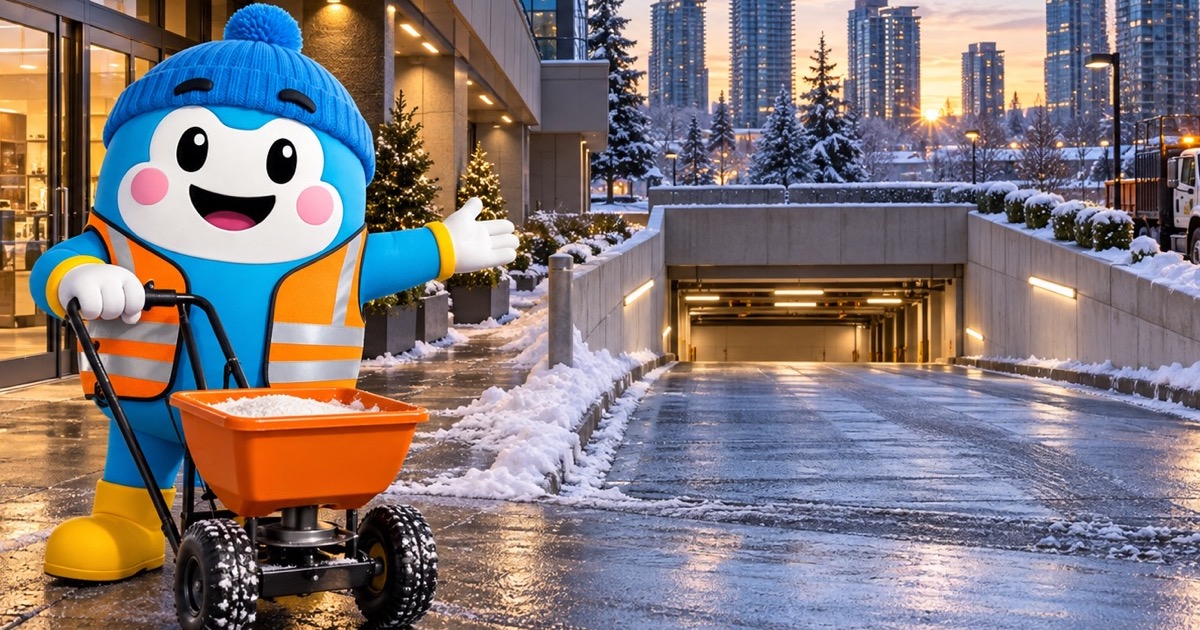
A Burnaby commercial snow-removal plan should start with the time the property needs to function. A retail entrance required before opening, a loading bay used overnight and an office parkade needed for the morning commute do not belong on the same clearing schedule.
This guide supports the main Burnaby snow removal page with a focused plan for commercial entrances, parkade ramps, hills, pedestrian routes and opening-time readiness. It is designed for property managers who need a clear scope rather than a vague promise to “take care of the snow.”
Work Backward From Opening Time
The first planning question is not how many centimetres may fall. It is when customers, employees, residents, suppliers or service vehicles begin using the property.
Build the route backward from that time:
- Confirm the required opening or shift-change time.
- Identify the minimum vehicle route needed for access.
- Identify the continuous pedestrian route from the public sidewalk to the entrance.
- Add accessible entrances, curb transitions and emergency exits.
- Schedule the parkade ramp, loading area and secondary parking lanes.
- Leave enough time for de-icing and a final inspection before users arrive.
During continuing snowfall, the first pass may focus on these operational routes rather than trying to finish every parking stall at once. The contract should explain that sequence so the site manager knows what “open” means.
Treat a Parkade Ramp as a Separate Zone
Sloped parkade access can stay icy after the surrounding pavement is clear. The ramp may be shaded, covered, painted or polished, and meltwater can collect at the bottom transition. Vehicle traffic then compacts any remaining slush.
A ramp plan should record:
- Grade and turning space
- Overhead height and equipment limits
- Trench drains and low points
- Approved ice-control product
- Temporary traffic-control procedure
- Snow-storage location outside the travel lane
- Whether an overnight or pre-opening refreeze check is required
The ramp should not be buried inside a general parking-lot line item. Its surface, drainage and operating risks are different.
For a deeper property-management checklist, see the Burnaby hills and parkade snow-and-ice plan.
Separate Customer, Staff and Loading Access
Commercial sites rarely have only one priority. A practical map distinguishes:
- Public sidewalk and customer entrance
- Employee entrance and staff parking route
- Loading bays and truck approaches
- Garbage, recycling and service-room access
- Fire routes and emergency exits
- Parkade entrance and exit lanes
- Accessible parking and curb ramps
The clearing order can then match the operation. A loading-dependent business may need the truck approach first, while a retail property may prioritize the public sidewalk and main entrance. An office or mixed-use building may need the parkade ramp open before the lobby receives heavy foot traffic.
Plan for Burnaby's Grade and Density
Burnaby conditions change noticeably across the city, but the service plan still needs to be based on the address rather than broad assumptions.
- Metrotown and Highgate: dense pedestrian activity, parkade ramps and limited snow-storage space can make hand clearing and timing as important as plowing.
- Brentwood and Willingdon: mixed-use towers, offices and commercial entrances may have overlapping resident, customer and employee routes.
- Lougheed and Government Road: sloped approaches, townhome access and commercial parking can require different equipment on the same route.
- Burnaby Mountain and Capitol Hill: grade, elevation and shaded surfaces can increase the need for advance treatment and refreeze checks.
- Big Bend and Marine Way: larger commercial or industrial sites may place more emphasis on loading access, truck lanes and staff parking.
These differences are why the site walk matters. City-level averages do not show a shaded ramp, a blocked drain or a loading dock that starts operating at 4 a.m.
Keep Drainage Open After the First Pass
Snow removal is not finished when the driving lane is visible. Meltwater can travel downhill, cross a walkway and freeze at a ramp bottom or entrance. Commercial traffic accelerates this cycle by carrying slush into the site.
Before winter, mark catch basins, trench drains, roof-drip lines and known low points. During service, keep snow piles away from drainage and inspect the downhill edge of the cleared area. Applying more salt does not correct a blocked drain or a pile placed where it sends water across the entrance.
The plan should also state who approves snow relocation if storage space fills during repeated events.
Define Ice Control Instead of Assuming It
A commercial quote should specify the treatment zones, trigger and product. Typical zones can include the main entrance, public sidewalks, accessible routes, loading approaches, parkade ramps and known shaded areas.
The proposal should answer:
- Is pre-treatment included when forecast conditions justify it?
- Is material included or billed separately?
- Which surfaces require a specific product?
- Who approves an extra treatment?
- Is a return check included after meltwater or refreeze?
This level of detail makes the service measurable. It also stops one person from expecting every parking stall to be treated when the contract covers only the pedestrian routes and ramp.
Match Equipment to the Site
A large plow is useful only where it can operate safely and store snow. Burnaby commercial properties may require a combination of plow trucks, compact equipment, snow blowers, walk-behind spreaders and hand crews.
The equipment decision depends on lane width, turning room, parked vehicles, curbs, overhead clearance and pedestrian separation. A narrow mixed-use entrance should not receive the same equipment plan as an open industrial yard.
For more detail on commercial scopes, review commercial snow removal and de-icing. Properties with extensive sidewalks can also use the snow-blower planning guide.
Build the Proposal Around Measurable Work
Before approving a Burnaby commercial contract, confirm that it lists:
- Opening time or operational deadline
- Included parking, loading and travel lanes
- Public and private pedestrian routes
- Parkade ramp and surface restrictions
- Service trigger and dispatch method
- First-pass priorities during continuing snow
- Salting or ice-melt zones
- Refreeze checks and additional visits
- Snow-storage limits and relocation approval
- Access instructions, gates and parked-vehicle rules
- Visit reporting and issue escalation
Pricing should be based on those surfaces and requirements. A single number without a defined scope is difficult to compare and even harder to manage during a storm.
Frequently Asked Questions
What should be cleared before a Burnaby business opens?
The site plan should identify the minimum vehicle route, a continuous pedestrian route to the main entrance, accessible access, emergency exits and any operationally critical loading or parkade area. The exact order depends on the business.
Why does a commercial parkade ramp need its own snow plan?
Ramps combine grade, drainage, traffic compaction and surface-specific ice control. The bottom transition can refreeze even when nearby flat pavement appears clear.
Is every parking stall cleared during the first pass?
Not necessarily. During continuing snow, the first pass may open entrances, travel lanes, accessible routes and critical loading access. Parking-stall detailing should be defined in the contract and coordinated around parked vehicles.
How is Burnaby commercial snow-removal pricing calculated?
Pricing depends on the measured vehicle and pedestrian areas, grade, hand work, equipment access, service deadline, ice-control scope, snow storage and expected return checks. A site review produces a more useful quote than a generic lot-size estimate.
Request a Burnaby Commercial Site Plan
Call 604-761-1518 or use the PlowWow quote form for a Burnaby commercial plan based on the property's opening time, access routes, ramps, drainage and snow-storage limits.