

News flashback · Historical event: January 2024 · Published October 29, 2026. This is a retrospective planning feature, not a current forecast or warning.
The historical starting point
ECCC’s review of 2024 identifies the mid-January western-Canada Arctic outbreak as a significant cold event. It provides regional context, not a measured account for every Port Moody street or property. This article does not claim a local snowfall amount, a particular road closure or a completed PlowWow response. Its value is in looking at a recurring operational question: what happens when a public pedestrian route meets the frontage and entrance of a private building?
Cold-weather reporting often uses the phrase polar vortex. NOAA explains that the circulation examined high in the atmosphere is distinct from the cold people encounter at the surface. We have not established a specific causal chain for a Port Moody event. The news flashback therefore uses the documented January 2024 cold outbreak as context and keeps its own publication date separate. Any practical example below is conceptual, not an interview, customer account or reconstruction of an incident at a real business.
The question a mixed-use property should answer first
Can a person follow one understandable pedestrian route from the agreed public arrival point to the entrance your property is responsible for maintaining? The answer needs more than a photograph of a plowed parking lot. A curb transition, frontage path, covered entrance and internal courtyard may involve different people. If the plan leaves a short gap between them, the length of that gap does not make it unimportant.
Start with a map that shows the property boundary and the expected approach. Mark public space as public and the privately agreed work as private. Ask the relevant authority or property representative to resolve an uncertain boundary. This article does not decide ownership from appearance or certify that a walkway meets every applicable standard. It offers a way to make the question visible before a service proposal is accepted, when the parties can still agree who does what and how to communicate a change.
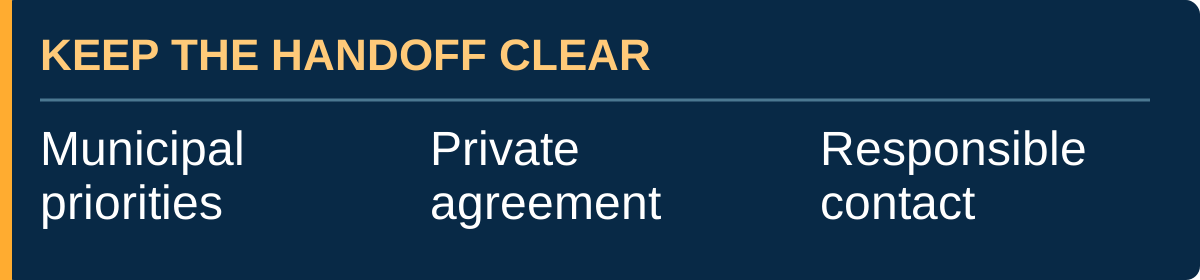
Read the municipal priorities as a separate layer
Port Moody publishes winter priorities for roads and pedestrian areas. Its current information distinguishes pedestrian areas near the Inlet Centre and Moody Centre stations from those farther away, and it describes separate road-maintenance priorities. Read the actual municipal page and maps for their full scope. A priority classification is not a prediction of the exact moment a particular frontage will be complete, nor is it a private contractor booking.
Keep that municipal layer beside, rather than inside, the private work instruction. For a property near a public route, identify where the municipal responsibility ends and the agreed private path begins. If a private owner has a frontage obligation, verify the current official requirements for that address and property type. Do not rely on this retrospective feature as a compliance certificate or assume that a nearby cleared municipal path means every connecting entrance has been attended to. The handoff still needs a named owner.

Original PlowWow editorial diagram. Planning sequence, not a site record or technical instruction.
Follow the pedestrian, not just the plow
A visitor’s route may begin at a transit stop, a parking location or another public approach. The private plan should identify the agreed point from which your contractor’s work is being discussed. Continue toward the building entrance and mark each turn, gate, ramp, shared stair or change in surface. A plan that starts halfway along the frontage may leave the reviewer unaware of the connection residents actually use.
For a conceptual mixed-use building, imagine retail doors at the street and a separate residential entrance reached through a side passage. The two approaches may need different coordination even though they share one address. Record both if both are in scope; do not describe the property as fully covered while leaving one unmentioned. This is an illustrative layout, not a real Port Moody client. Its purpose is to show why the route should be described in plain language that an unfamiliar worker can follow without local knowledge.
Give shared spaces a responsible contact
A building may have a strata representative, commercial tenants and a property manager involved in winter arrangements. Decide who can approve the shared plan and who communicates with the service provider. If more than one party can request work, explain how competing instructions are resolved. An inbox full of messages is not a substitute for one current accepted route and a person authorised to make a decision.
Tenants should know which frontage and entrance work is included and which remains their separate responsibility. A concise notice can link to the current plan without publishing private telephone numbers or internal access information. Keep the operational version available to the people who need it. A resident-facing update should not promise a verified completion time unless the real service arrangement supports that claim. Distinguish a request, an acknowledgement, an attended visit and a confirmed result rather than treating all four as the same event.
Coordinate frontage access with business activity
A commercial entrance can be busy before the first customer arrives. Deliveries, waste collection, opening routines and staff parking may compete for the same narrow area. Put those ordinary operations into the briefing conversation. The purpose is not to promise that weather can be scheduled around business hours; it is to show the constraints that affect access and the decisions that need agreement.
Ask where a service vehicle can stop without blocking the planned pedestrian route, and who will arrange access to a gated or enclosed area. Mark obstructions that are present only at certain times. If the property expects a special opening arrangement, confirm it explicitly rather than letting it appear only in a casual message. Changes in access may affect equipment, labour or the ability to complete the agreed work. A clear proposal should explain how those situations are handled instead of making a universal all-hours guarantee.
The small connection may require a different method
An open lot and a short entrance passage should not automatically receive the same equipment assumption. Narrow widths, overhead structures, surface changes and a tight turn can influence what is suitable. Give the reviewer a photograph of the difficult connection and a note about how it is used. The actual method must be assessed and agreed for the site; this article does not authorise a particular machine to operate in a pedestrian area.
PlowWow’s rough shared-walkway planning includes stairs that belong to the agreed common route. Individual-unit stairs and private unit entrances are excluded unless specifically agreed. Put this distinction into the accepted scope. You do not need to count every stair to start the conversation; identify the shared route and provide enough context for a review. Avoid a broad phrase such as every entrance if the proposal actually concerns only the shared building approach. The words should describe the work that can be understood and confirmed.
Original PlowWow editorial diagram. Planning sequence, not a site record or technical instruction.
Snow storage must preserve the journey
Displaced snow needs a suitable location that does not quietly remove the connection you are trying to maintain. Mark proposed storage areas and ask the responsible reviewer to confirm their suitability. The entrance approach, sight lines and movement through the property all deserve attention. A corner that is empty in a summer photograph may have another function in winter or during a busy operating period.
Plan how a storage decision can change after repeated work. Who may approve a different pile location? When would separate relocation or hauling be considered? Off-site removal is not assumed to be included in standard clearing and needs a separate confirmed scope and current charges. No amount, price or hauling commitment is established by this article. The useful step is to give the service reviewer enough information to explain the options without discovering a storage conflict after the first pass through the property.
Keep a treatment-only decision visible
The frontage may need discussion even when the requested work is not a full snow-clearing visit. Separate the clearing scope from treatment-only arrangements and identify which surfaces are included in each. Do not choose a product or dose from a dramatic historical headline. The actual decision depends on surface and weather conditions, the selected material’s instructions and an appropriate application method. This feature does not supply a universal salting prescription.
If the property has sensitive surfaces or requests an alternative material, state that before the quotation is accepted. Ask what records will identify the treated area, material and visit. A marketing label does not explain product suitability, and a photograph of granules does not establish that the correct method was used. The point is to make the agreement reviewable. Keep any result claim tied to actual evidence and avoid promising that documentation alone prevents an injury, resolves a dispute or changes insurance terms.
Build a reporting route that people can use
A useful report describes a location, condition and time without requiring the sender to diagnose the cause. Give residents or staff the segment names from the plan so they can identify the side passage or shared ramp accurately. Ask for relevant photographs when appropriate and permission to use them for the operational review. Keep personal details and unrelated people out of any public material derived from those records.
Decide who receives a report and who can authorise follow-up. A property message to a manager is not automatically a contractor work order. Similarly, an online enquiry is not a confirmed visit. If a service arrangement includes review or return-visit provisions, keep those provisions with the current scope. This article does not invent a response time or describe an automatic PlowWow dispatch system. A calm, factual reporting route makes the next decision clearer even when the actual condition still needs someone on site to assess it.

Original PlowWow editorial diagram. Planning sequence, not a site record or technical instruction.
Use network geography without inventing coverage
Port Moody is connected to neighbouring communities through everyday work, shopping and travel. That does not mean a contractor can combine every nearby request into one guaranteed route. A route review needs actual addresses, access requirements, timing and the work at each property. A neighbouring pin on a map is a reason to ask about efficiency, not proof of an automatic discount or a reserved service slot.
For a mixed-use property, include the operating constraints that make its timing different from a nearby residence. If several owners want a coordinated review, identify who represents each location and keep the scopes distinct. Do not combine unrelated buildings merely to make a price look attractive. Confirm availability, terms and any efficiency adjustment directly. This is practical geography for a business discussion, not a claim that PlowWow has a crew, contract or completed route at every place mentioned in this feature.
Review the proposal from the entrance outward
After receiving a written proposal, read it from the building entrance back toward the agreed arrival point. This reverse check often exposes an assumption hidden in the original route description. Is the last landing included? Does the shared passage reach the frontage? Are snow storage and treatment decisions understandable? Put the two descriptions side by side and mark the differences before comparing only the total.
Then identify what still requires confirmation. A starting estimate may be useful without being a site inspection or accepted contract. The PlowWow quote route can begin that discussion with the actual address and requested areas. Confirm heavy-event provisions, return visits, material allowances and access problems in the final arrangement. Snow Intelligence remains first-year beta; nothing in this flashback announces tested automated matching, forecasts or bookings. A page that helps prepare an enquiry is valuable when its actual role is explained honestly.
Keep the event, illustration and current decision separate
The historical event discussed here occurred in January 2024. This article was prepared in October 2026. The new PlowWow scene is an imagined winter setting featuring the established Wow mascot, not a photo of that event or a customer site. Those three facts should remain clear when the article is shared. A retrospective can prompt useful preparation without pretending that old conditions are occurring now.
For present weather decisions, consult current official forecasts and warnings. For a Port Moody property review, call 604-761-1518 or email wow@plowwow.com. Explain the pedestrian connection, building use and requested scope. Do not assume the public road, frontage and internal entrance are one interchangeable job. The practical lesson from a cold-weather flashback is to make the last few metres as understandable as the largest part of the plan, with a real recipient and a written decision attached.
Sources, dates and related planning
Historical event: January 2024. Publication: October 29, 2026. Primary sources were checked for this retrospective; municipal guidance describes the current published framework rather than proving a January 2024 response at any property.
- ECCC — Canada's 2024 impactful weather stories, including the January Arctic outbreak.
- NOAA/NWS — what the polar vortex is.
- Port Moody — official snow and ice information.
- Port Moody service-planning context.
- Current Snow Intelligence beta status.
- The separate Langley City and Township planning guide.
Hero and share artwork: original AI-assisted PlowWow editorial illustrations using the approved established Wow character. Imagined scenes, not archive footage, customer photographs or completed-work evidence. Narrow planning graphics: original PlowWow editorial artwork.