
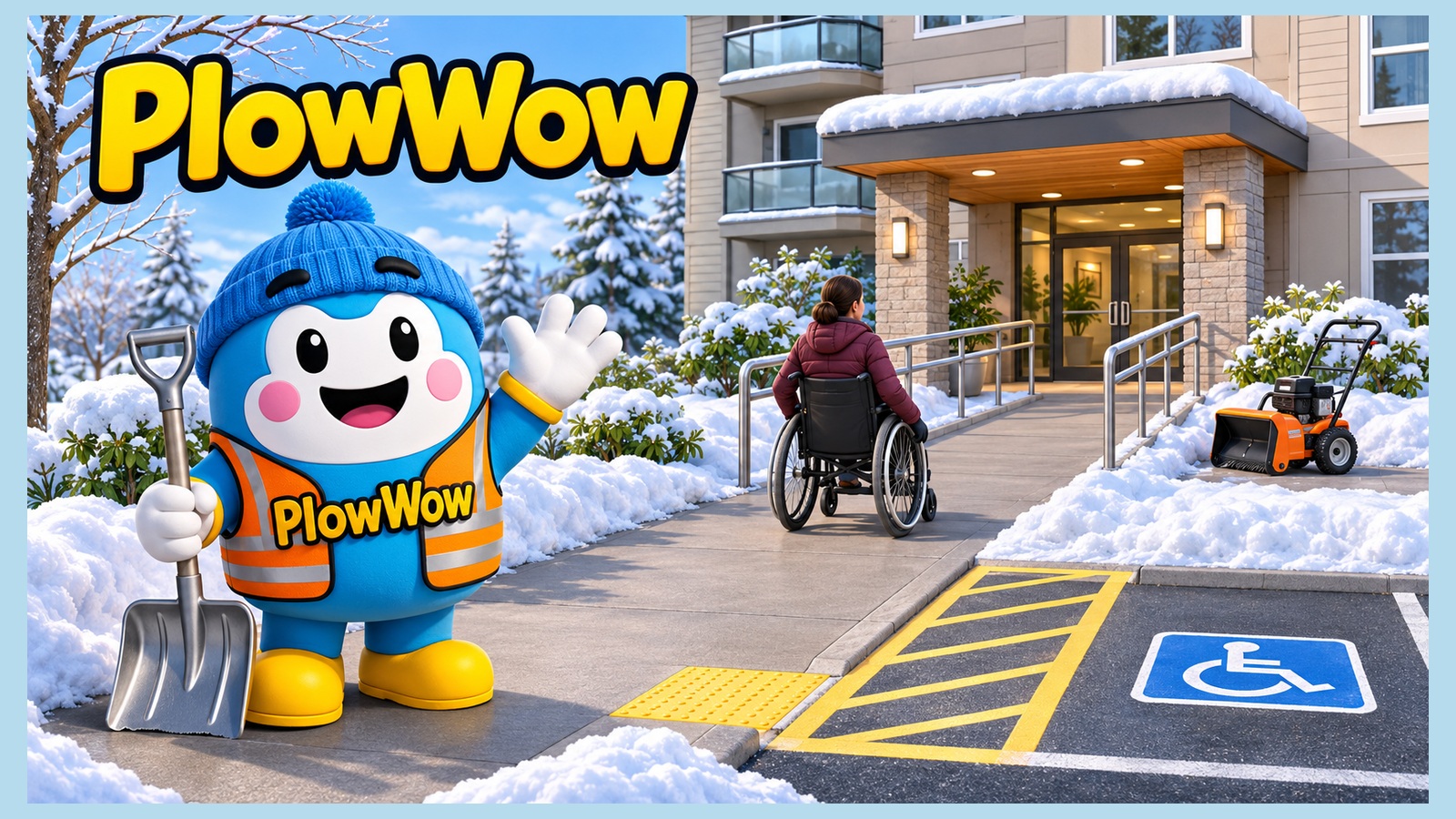
Original AI-generated PlowWow editorial illustration. Imagined property and winter access route; not a customer photograph or a technical design drawing.
By the PlowWow team · November 13, 2026 · Strata winter planning
A cleared parking lot can still leave someone unable to reach the door. The missing connection might be a snow ridge across an access aisle, a ramp landing used for storage, or a narrow walkway that ends at an uncleared entrance.
For a strata council or property manager, a useful winter access plan follows the complete journey. Start with the resident’s destination and the route they can actually use, then give the clearing crew a scope that protects that connection.
Does a BC strata need an accessibility committee?
An ordinary private strata corporation is not a prescribed class in the current Accessible British Columbia Regulation. Being a strata alone therefore does not trigger the same committee, plan and feedback requirements that apply to prescribed organizations. This is a reading of the regulation’s scope, not an exemption from other duties.
Does a strata need an accessibility plan?
There is no blanket requirement under that regulation for every private strata to prepare the formal accessibility plan required of prescribed organizations. A written winter access plan is still a practical management tool. An individual accommodation request, a particular property or another applicable requirement may call for specific action; a generic checklist cannot decide that question.
The BC Human Rights Tribunal’s strata guidance explains disability discrimination in strata services and the duty to accommodate without undue hardship. It gives inaccessible common areas as an example and requires evidence to justify an undue-hardship defence. A council should assess a resident’s access needs rather than assume that having no statutory committee requirement settles the matter.
Section 72 of the Strata Property Act also addresses repair and maintenance of common property and assets, subject to its qualifications. Check the actual strata plan, bylaws, contracts and allocation of duties before assigning a winter task. This guide is general planning information; obtain property-specific advice where duties or an accommodation are disputed.
What about Vancouver’s committee?
Yes. Vancouver’s Accessibility Committee advises on barriers and its Accessibility Strategy. That municipal arrangement does not turn a private strata council into the same kind of prescribed body. The City also lists its related Persons with Disabilities Advisory Committee.
Map a continuous winter route
The following is PlowWow’s practical planning checklist, not a statutory design standard or a clearance-time promise. Walk the property with people who use the route, where they wish to participate. Record barriers and ask what would make the connection usable without collecting unnecessary medical details.
- Mark arrival points. Include accessible parking spaces and access aisles, drop-off areas, and the connection to the public sidewalk. Identify the property boundary so a gap between contractors or agencies is visible.
- Follow the route to the door. Mark curb ramps, ramps, landings, gates, door approaches and any necessary alternate entrance. Stairs do not replace an accessible route for someone who cannot use them.
- Protect snow-storage exclusions. Show where piles must not block access aisles, curb ramps, entrances, sightlines or the chosen pedestrian connection. Agree on storage locations before the first push.
- Identify equipment transitions. A truck pass may leave edge cleanup for a smaller machine or hand crew. Put that handoff in the scope, including who checks the connection after lot clearing.
- Plan repeat checks. Identify locations affected by drainage, refreezing or snow shed from roofs. Decide who inspects, who receives reports and how an unresolved barrier is escalated.
Do not adopt an invented universal path width or slope from an online checklist. Existing conditions, applicable standards, the building and the people using it need assessment by the appropriate professionals.
Put responsibilities in one short record
Use a simple route map with named contacts and a dated task list. Record who clears each section, the agreed priorities and service triggers, who handles the area outside your contractor’s scope, and what happens if the usual route becomes blocked. Any temporary alternative should be assessed for actual usability and communicated clearly.
Hypothetical planning exercise: the parking contractor finishes the vehicle aisles, but a windrow remains across the pedestrian connection. Who reports it? Which crew removes it? How is the route checked afterward? If the contract and route map do not answer those questions, resolve the gap before relying on the plan.
Give residents a usable way to report a barrier
Offer a clear council or manager contact and an alternative for someone who cannot use an online form. Ask for the location, the access problem and a safe way to follow up. Log the response and the outcome. Handle disability-related information privately and discuss relevant accommodation needs directly with the person affected.
Review the plan after a reported problem or a change to entrances, parking, landscaping or contractor scope. A document that says “clear walkways” is less useful than a route map that names each connection and its responsible party.
Ask for a property-specific scope
PlowWow serves Vancouver, the Lower Mainland and Fraser Valley. Bring your route map, known access barriers, snow-storage constraints and existing responsibilities to a winter-service discussion. Scope, timing, availability and pricing require a written property-specific quote; this article does not promise a particular response time or outcome.
Ask PlowWow about your property.
Sources checked November 13, 2026. Municipal accessibility planning and private strata obligations are distinct. The practical checklist above is PlowWow editorial guidance, not a certification that a property meets legal or technical requirements.