By the PlowWow editorial team · September 30, 2026
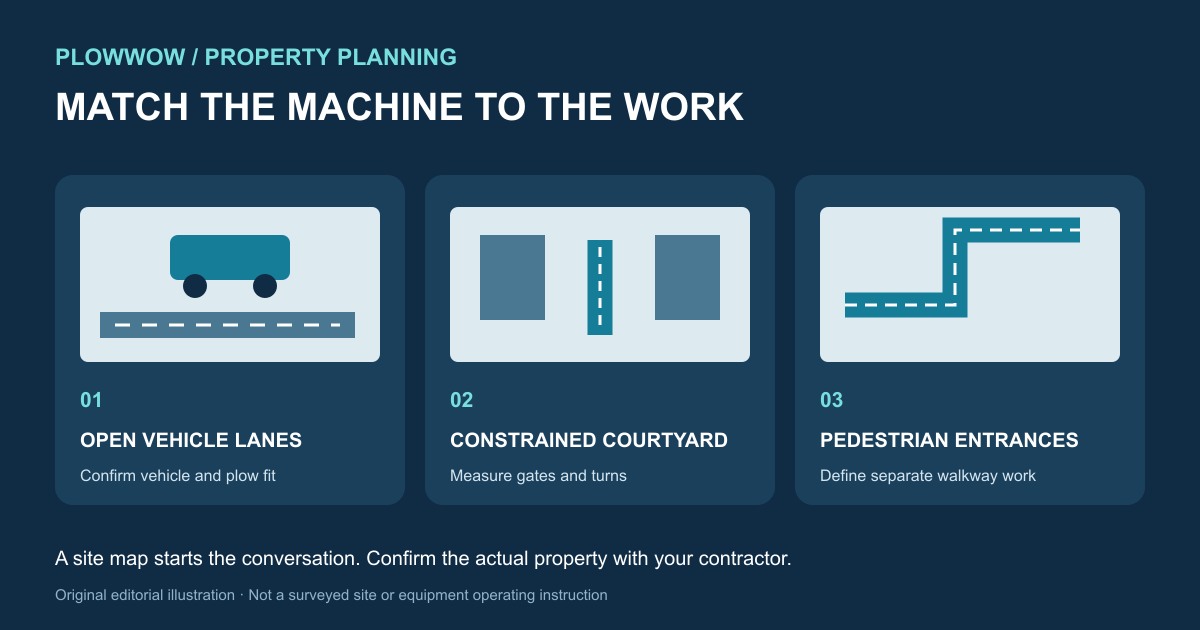
Visual: original PlowWow editorial diagram. The three work zones illustrate planning questions, not a surveyed property or a prescribed equipment layout.
A large plow can look impressive in an equipment photo, but the useful question is whether the crew can reach every surface in your service agreement. A commercial site may combine an open parking lot, a narrow service court and entrances that require separate pedestrian work. One machine does not automatically cover all three.
Before requesting a winter-service quote, divide the property into work zones. This gives contractors enough context to explain their proposed equipment mix and gives the property manager a clearer way to compare scope.
Start with access, not blade size
Record gate widths, overhead restrictions, tight turns, parked vehicles and any surface that cannot accept the proposed equipment. Measurements should identify where they were taken; a nominal driveway width is not necessarily the usable space between bollards. Ask the contractor to confirm clearance for the complete machine and attachment, including turns and working positions.
Photograph the entrance and the route through the site. Include anything that changes during business hours, such as delivery trailers, temporary fencing or bins. A route that works on an empty Sunday may be blocked during a weekday snowfall.
Ask where truck-mounted equipment fits
A truck plow may suit the accessible vehicle areas in a contractor's plan. That does not establish that a particular truck and blade are compatible. WESTERN's Quick Match tool checks approved applications against vehicle details. Equipment owners should confirm the actual configuration, loading and manufacturer requirements with their dealer.
For the property manager, ask which areas the proposed truck will cover and where it cannot work. Request a separate explanation for narrow corners, parked-car edges and entrances rather than assuming they are included in a general plowing price.
Give compact equipment a defined job
A contractor may propose a compact loader, tractor or other smaller machine for constrained areas. Ask why that choice fits the site. Discuss access, turning space, attachment width, surface protection and where snow will be moved. “Compact” is a category, not proof that a machine will fit through your gate or suit every paved surface.
Also clarify whether the machine remains on site or arrives by trailer. If delivery is needed, identify a practical unloading area and who keeps it available. Include any agreed storage arrangement in the written scope.
Keep pedestrian work visible in the quote
List stairs, entrance landings, walkways and access routes separately. Identify the route people actually use between parking and the door, including alternate entrances used by staff or residents. Ask what equipment or hand work is proposed and how that work connects with vehicle-area clearing.
Avoid comparing proposals only by the number of machines promised. Compare the surfaces included, the access assumptions and the process for reporting a blocked area. Those details explain much more about the service you are buying.
Prepare one brief for every bidder
Send the same marked plan, current photos, operating hours and access restrictions to each provider. Ask for exclusions and any extra equipment charges in writing. Our commercial quote-request guide provides a useful starting checklist.
For commercial snow-removal planning, send PlowWow your location and site details through the quote request. Equipment assignments and service availability need confirmation for the actual property.