By the PlowWow editorial team · September 30, 2026
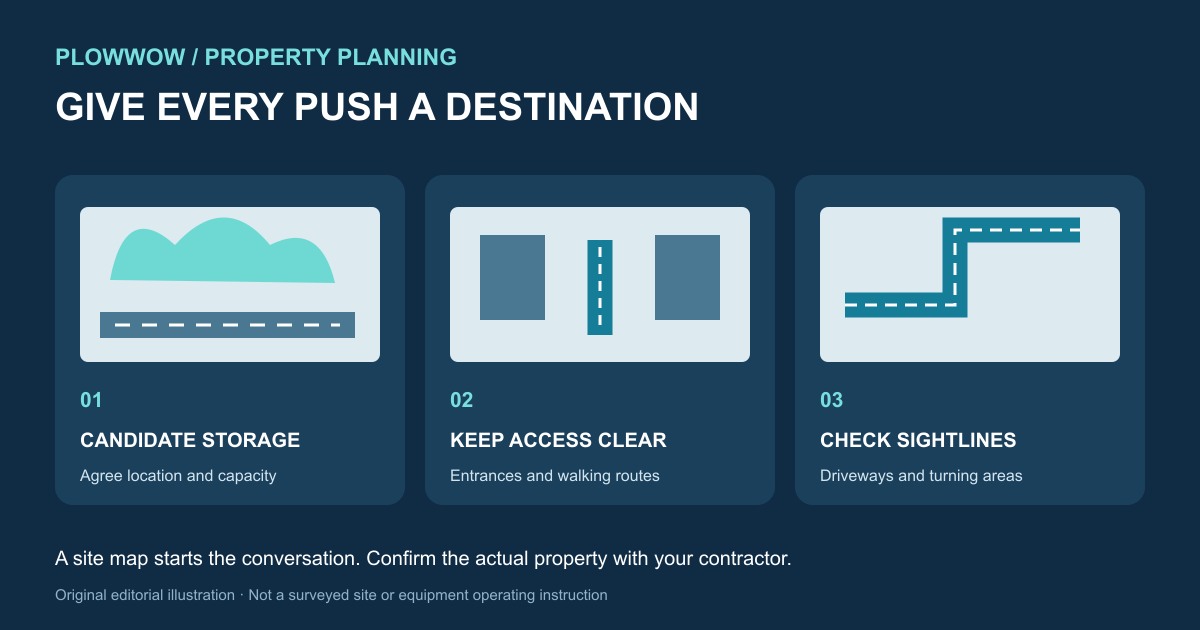
Visual: original PlowWow editorial planning diagram. The storage zone is illustrative; a contractor must assess the real site's access, drainage and constraints before work.
Snow clearing changes a property's layout. Space that was empty in October can become a pile beside an entrance, a narrowed turning area or a blocked section of parking during repeated service visits. Deciding where snow goes is therefore part of the service plan, not an instruction to improvise once the lot is white.
For a commercial or strata property, prepare a simple site map before the season. It does not need to be a polished drawing. A current plan or aerial image with clear labels can start the discussion, provided the contractor checks conditions on the ground.
Separate candidate storage from protected space
Mark possible storage areas in one colour and areas that must stay clear in another. Include entrances, pedestrian connections, delivery access, utility access and the visibility needed at driveways. Ask the site team to identify any additional operational restrictions before the plan is agreed.
BOSS's snowplow owner's manual, in its parking-lot guidance, advises operators to establish the customer's preferred snow-piling locations and avoid piles that obstruct driveway visibility. This is useful background for the discussion, not a replacement for a site-specific assessment.
Consider where meltwater travels
Walk the property with someone who knows its wet-weather behaviour. Identify drains, low points and places where runoff crosses a walking route. A proposed pile location should be discussed in that context, especially if occupants have previously reported water collecting near an entrance.
Do not assume that an apparently unused corner is suitable because it is out of the way. Ask how the contractor will evaluate the location and how the property team should report changing conditions. Record the agreed observation and follow-up process alongside the map.
Plan for the second and third visit
A storage location that accommodates one clearing event may not remain practical after repeated accumulation. Ask where the next push would go and what conditions would trigger a discussion about moving or removing stored snow.
Agree who can approve extra work and how the provider will explain the proposed scope and price. Hauling, additional equipment and disposal should not be treated as included unless the agreement says so. There is no useful universal pile-size limit for every site; the decision depends on the property's constraints and the proposed operation.
Include the people who use the site
Show the draft to the person responsible for deliveries, tenant communications and access. A storage choice that looks harmless on a plan may interfere with bin collection, a loading routine or a rarely used door. Invite those observations before the map becomes an instruction to the crew.
Keep the approved version easy to find. Put its date and the property contact on it, and make clear which version replaces the previous one. When access arrangements change, send the revision to the contractor rather than relying on a verbal message passed through several people.
Review what happened after service
Compare the actual clearing and storage locations with the agreed plan. Photograph an issue from a useful angle and report the location, time and effect on access. Our after-service checklist explains how to make that follow-up clearer.
For help scoping a property, use the PlowWow quote request and include your marked map with the site details. Contractors explaining their own winter services can also explore snow-removal marketing through BuildersHaus. Documented planning is useful evidence; it should never be turned into an unsupported promise that a property will stay hazard-free.