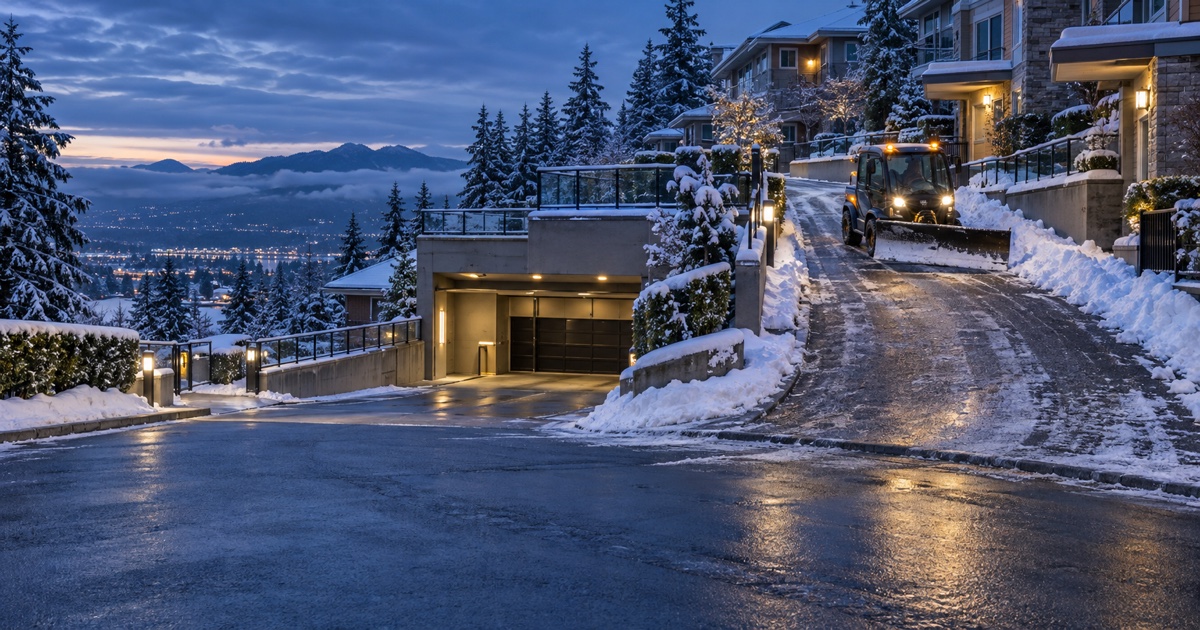
Coquitlam cannot be planned as one flat snow route. A property on Burke Mountain or Westwood Plateau may be receiving and holding snow while a lower site in Maillardville or City Centre is dealing with rain, slush or overnight ice. Within one strata property, the parkade entrance, upper drive aisle and shaded walkway can also have different surface conditions at the same time.
This guide complements our main Coquitlam snow removal page with a focused plan for elevation, steep vehicle access, pedestrian routes, drainage and repeat ice checks.
Coquitlam's Public-Sidewalk Rule Uses a 10-Hour Window
The City of Coquitlam's Snow Response Request Tool explains that owners and occupants are responsible for clearing ice and snow from sidewalks bordering their property within 10 hours of every snowfall. The City's Winter Wise information remains the best starting point for current municipal responsibilities and snow-response updates.
This is different from assuming that municipal road clearing will also handle the property's sidewalk. The City prioritizes public roads, while the bordering sidewalk remains part of the owner's or occupant's winter responsibility. A service map should therefore include every public frontage as well as the property's private paths.
Coquitlam's Road Plan Confirms That Grade Matters
The City's official Coquitlam Snow Response Plan map uses priority levels for public roads. Its description of Priority 2 routes specifically includes subzones with a high percentage of local roads on grades greater than 10 percent.
That municipal approach is useful context for private-property planning. Grade changes vehicle traction, equipment access, drainage and the place where meltwater collects. A steep strata driveway or parkade approach should be treated as a distinct operating zone rather than another line item in the lot area.
Divide the Property Into Elevation and Surface Zones
Before winter, build a map that records how water and traffic move through the property. Mark:
- Public sidewalks along every frontage
- Upper and lower vehicle entrances
- Parkade ramps and garage aprons
- Sloped drive aisles and sharp turns
- Accessible routes and curb transitions
- Exterior stairs, landings and raised walkways
- Catch basins, trench drains and low points
- North-facing or heavily shaded surfaces
- Roof and canopy runoff near entrances
- Primary and overflow snow-storage areas
Add the property's elevation-related trouble spots from previous winters. If an upper lane repeatedly accumulates while the lower entrance stays wet, or if one bottom ramp transition refreezes every night, those facts should control the service sequence.
For multi-unit planning, see our strata snow-removal service. Retail, office and industrial properties can also review commercial snow clearing.
Burke Mountain and Westwood Plateau Need Earlier Decisions
Higher Coquitlam neighbourhoods can experience different precipitation and pavement temperatures from lower areas. The practical response is not to promise a universal snowfall amount. It is to define property-level triggers that consider forecast precipitation, measured accumulation, surface temperature and safe equipment access.
A high-elevation contract should answer:
- What conditions trigger pre-treatment or dispatch?
- Where will equipment be staged if the surrounding road becomes difficult?
- Which steep route must open first for residents or emergency access?
- What product is approved for the ramp and walkway surfaces?
- When will the site be checked for continued accumulation or refreeze?
The plan should also identify an alternative contact and access method. A crew that cannot enter because of a locked gate or parked vehicle cannot complete a time-sensitive hill route.
Treat Every Parkade Ramp as a Separate Service Zone
A parkade ramp combines grade, vehicle compaction, drainage and often a change of surface. Covered sections may remain colder or collect wind-blown snow at the entrance. Trench drains can be hidden by slush, and the bottom transition may freeze after water runs downhill.
The ramp scope should specify:
- Whether the ramp must be temporarily closed during service
- Equipment height, width and turning restrictions
- The approved snow-placement area
- The treatment product approved for concrete or coated surfaces
- The trench-drain and bottom-transition inspection
- The time or condition that triggers a return check
Do not rely on the phrase “driveway included.” A steep concrete ramp with resident traffic requires more detail than a level asphalt lane.
Open One Continuous Pedestrian Route First
Residents, customers and staff need a complete route, not isolated cleared patches. The first pedestrian pass should connect the public sidewalk, accessible entrance, main door and any required garbage or service access.
Priority areas often include:
- Public sidewalk frontage within the property's responsibility
- Main lobby or commercial entrance
- Accessible ramps and curb cuts
- Exterior stairs and handrail zones
- Emergency exits and fire-service access
- Walkways between visitor parking and the building
A snow blower may help on longer narrow routes where piling space is limited. See our guide to snow blowers for sidewalks. Hand work is still needed at doors, stairs and tight corners.
Control Water Before the Overnight Temperature Drop
Coquitlam's slopes make meltwater movement predictable if the property is mapped properly. Water travels downhill and collects at a drain, curb line, ramp bottom or roadway transition. If that water freezes, a surface that appeared clear in the afternoon can be hazardous before dawn.
After clearing, inspect:
- The downhill edge of every ramp and sloped path
- Catch basins beside snow piles
- Trench drains at parkade entrances
- Roof-drip areas near doors and stairs
- Wheel tracks where slush has been compacted
- Shaded concrete beside retaining walls or dense trees
Ice-control material should be applied according to the surface and conditions. More product is not a substitute for opening a blocked drain or moving a poorly placed snow pile.
Build Return Visits Into the Scope
A return visit may be required for one of three different reasons: continued snowfall, snow moved by traffic or wind, or meltwater refreezing after the first clearing. These triggers should be written separately so the property manager knows what is automatic and what requires authorization.
For a hillside strata, the overnight refreeze visit may matter more than a small additional accumulation. The scope can identify a specific list of recheck points—the ramp bottom, shaded sidewalk, upper entrance and drainage path—instead of repeating the entire service route without purpose.
Keep Snow Storage From Creating a New Hill Hazard
Snow stored at the top of a slope can melt across the route below. A pile beside a ramp can narrow sightlines or reduce turning room. Snow stored over a catch basin can keep sending water across the same walkway for days.
Mark acceptable storage locations and areas where piles are prohibited. Dense developments should also define the point at which snow relocation or hauling is required. The street, bike lane, public sidewalk and neighbouring property are not default overflow areas.
Match Equipment to Grade and Access
Equipment selection should account for the steepest grade, tightest turn, overhead clearance and surface finish. A machine suited to an open lower parking area may not be safe or effective on an upper townhouse lane. Conversely, small equipment that fits a ramp may take too long to clear a broad commercial lot.
The plan should separate:
- Machine-clearing zones
- Hand-work and snow-blower zones
- Surfaces requiring a specified ice-control product
- Areas that need parked vehicles moved first
- Areas where equipment cannot safely operate
These distinctions make the quote more accurate and reduce last-minute improvisation during the storm.
Use Records to Improve the Next Coquitlam Route
A useful service record can include arrival and departure time, weather, observed surface conditions, areas cleared, treatment zones, product used, access problems and photos of priority routes. Photos should document the work without exposing private resident information.
If the same upper lane or ramp transition repeatedly refreezes, the record should lead to a change in the next plan: earlier treatment, a drain check, a revised pile location or a scheduled overnight return. For dispatch and reporting options, see the PlowWow snow-removal management system.
Questions to Settle Before Signing a Coquitlam Contract
Ask for clear answers to these points:
- Which forecast, accumulation or surface-temperature conditions trigger service?
- Are higher-elevation triggers different from lower-site triggers?
- Which ramp, roadway and pedestrian route must open first?
- Are public sidewalks included within the 10-hour compliance plan?
- Which surfaces receive salting or de-icing?
- Is treatment product included in the quoted price?
- What triggers an overnight refreeze check?
- Where can snow be stored without creating downhill runoff?
- How will blocked access or parked vehicles be reported?
- What record will the property receive after each visit?
Coquitlam's neighbourhood guides provide more localized examples, including Burke Mountain strata snow removal, Westwood Plateau parking-lot snow removal and Coquitlam Centre strata and commercial service.
Frequently Asked Questions
How quickly must Coquitlam sidewalks be cleared?
The City says owners and occupants must clear snow and ice from sidewalks bordering their property within 10 hours of every snowfall. Check the City's official Winter Wise and boulevard-maintenance information for current requirements.
Why does elevation change a Coquitlam snow contract?
Higher and lower areas can experience different precipitation, accumulation and pavement temperatures during the same system. Trigger conditions, staging and revisit timing should be based on the actual property rather than one citywide assumption.
Why does a parkade ramp need a refreeze check?
Water and compressed slush move downhill and collect at the bottom transition or trench drain. That moisture can freeze after the main clearing is complete, especially on shaded concrete.
Is de-icing automatically included with plowing?
Only when the scope says so. The quote should identify treatment zones, triggers, approved products and whether the material is included or billed separately.
Request a Coquitlam Elevation-Based Plan
Call 604-761-1518 or use the PlowWow quote form for a plan based on the property's elevation, grades, sidewalks, drainage and storage limits. Measuring the real route produces a better scope than treating every Coquitlam property as the same winter site.