Coquitlam Strata Snow Equipment: How to Clear the Parking Stalls
By the PlowWow editorial team · October 4, 2026 · Winter 2026–2027 planning guide
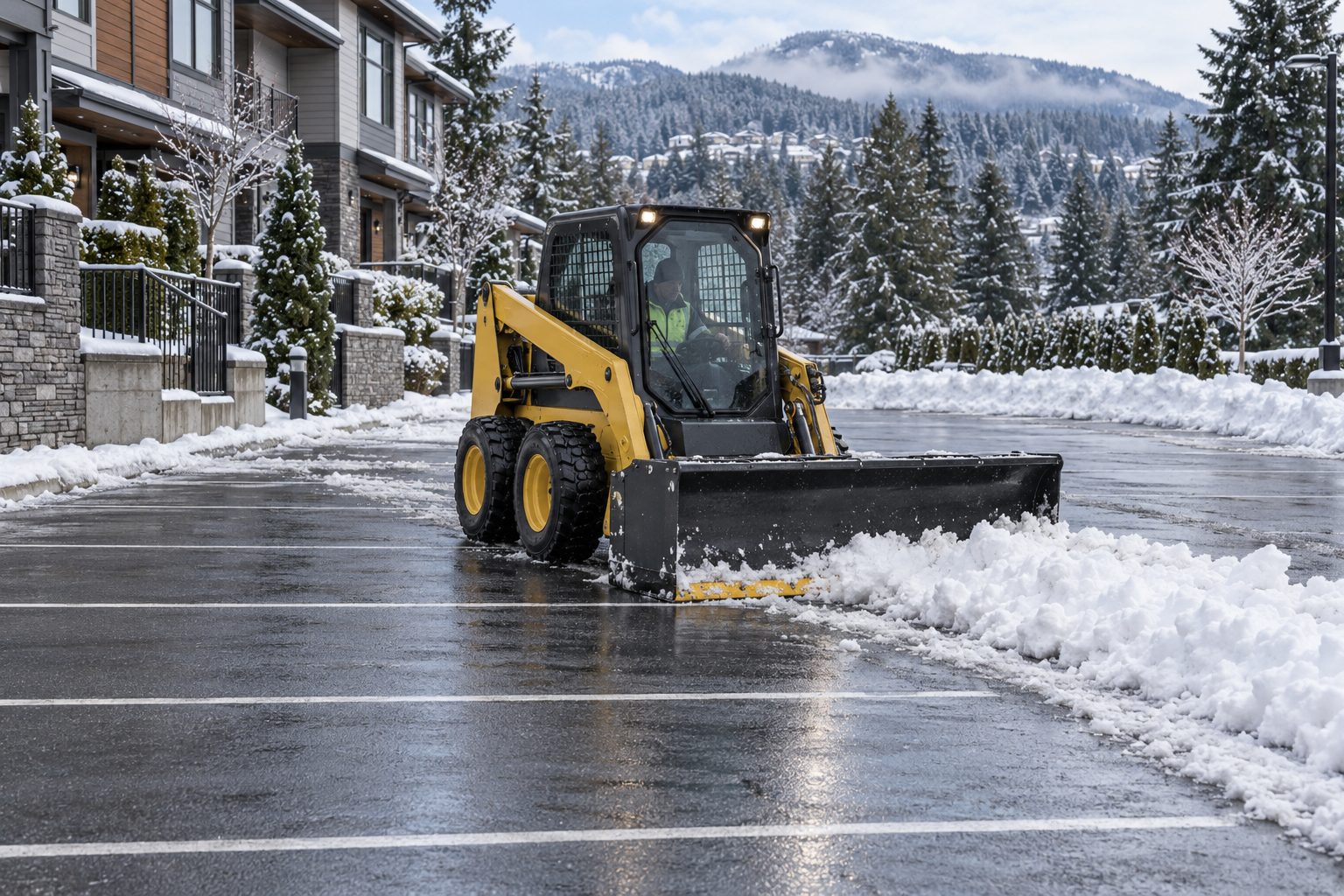
Visual: AI-generated editorial illustration created for PlowWow. Empty stalls show the access needed for a clearing pass; this is not a documented Coquitlam job or a recommended machine for every site.
Which equipment fits this property?
For Coquitlam townhouse parking, plan vehicle movements before choosing the machine. A truck may handle accessible aisles, compact equipment may handle released stall rows, and a loader may support larger-volume relocation or hauling. Keep pedestrian work separate and identify where the snow can be stored without sacrificing required access.
“We need every parking stall cleared” is a reasonable objective for a Coquitlam strata. It is not yet an equipment specification. Before deciding whether you need a truck, skid steer or front-end loader, work out how vehicles will move and where the displaced snow can go.
For winter 2026–2027, treat drive aisles, resident stalls, visitor parking, entrance walks and storage areas as separate tasks. A townhouse complex on Burke Mountain or Westwood Plateau may have a different exposure and access pattern from a commercial property near Coquitlam Centre. Use the address and site survey rather than assuming conditions are identical across the city.
Start with a parking plan residents can follow
Assign a strata contact who can release a work zone and communicate a realistic vehicle-moving window. Mark an initial holding area that does not block fire access or the route to the building. If there is no practical place for vehicles to wait, identify that limitation before promising complete stall clearance.
An illustrative sequence is:
- Open the agreed priority entrance and travel aisle, with pedestrian access managed separately.
- Clear an available holding area and identify which stall group will be released next.
- Move vehicles out of that group before equipment enters; keep residents outside the working zone.
- Clear the vacant stalls and their agreed edges, then release the next group.
- Record any obstructed spaces and arrange the agreed follow-up instead of treating them as completed.
This is a planning example, not an operating procedure for every layout. The contractor must confirm safe sequencing and equipment movements. Give residents advance instructions; do not have people move between operating machines to save a few minutes.
Truck, skid steer or loader?
A plow truck can suit the common drive aisle and open ground-level areas where its turning path works. It can be less useful in short stall rows boxed in by buildings, cars and landscaping. Ask how it will pull or push snow out of those spaces rather than accepting “parking included” as a complete answer.
A skid steer or other compact loader may be considered for tighter accessible work areas. The chosen blade, pusher or bucket must match the carrier and the task. Bobcat's snow-attachment overview illustrates the range of attachments available across compact equipment. It is a starting point for questions, not proof that any one model is suitable for your stalls.
A front-end loader becomes relevant when larger-volume relocation, storage management or loading for hauling is needed and there is sufficient working room. It is not automatically better at finishing around parked vehicles or small fixtures. The equipment plan may combine a truck for aisles, a compact machine for released stalls and hand work at detailed edges.
Sidewalks need their own equipment decision
An ATV or UTV plow may fit a broad, continuous authorized path. Measure gates, corners and the attachment's working width, and confirm that the surface can accept the vehicle. A narrow townhouse walk, staircase or landing may instead require appropriately sized walk-behind equipment and hand clearing.
Keep accessible stalls, curb transitions and the walking route to the entrance connected. Clearing the centre of a drive aisle does not clear those connections. The City of Coquitlam's boulevard guidance says sidewalk snow and ice must be removed within 10 hours of snowfall ending or ice forming. Build the applicable frontage requirement into the schedule and verify current rules before winter.
Plan storage before the first pile forms
Designate where snow can accumulate without burying hydrants, blocking sightlines, covering drains or consuming stalls that the strata must keep available. Identify where meltwater will travel. The convenience of pushing toward the nearest downhill edge does not make it an acceptable storage location.
Agree what happens when the storage area is full. Relocation within the site, loading onto trucks and off-site disposal are separate scopes and can need different equipment and authorization. State how those costs are approved. If the goal is to recover all usable parking, the snow destination matters as much as the clearing machine.
Define completion and ongoing care
List accessible surfaces, vehicle-related exclusions, protected wheel stops and curbs, the follow-up process and service documentation. Mechanical removal does not guarantee ice-free pavement. Include ongoing ice monitoring, treatment and reporting, especially where drainage or shade affects conditions.
For a useful quote, send the stall map, photos, narrowest access dimensions, storage proposal and resident communication plan. Review Coquitlam snow-service planning and our elevation and snow-management guide, then request a property assessment. For larger lots and loader decisions, see the Langley equipment guide.
Frequently Asked Questions
Does a Coquitlam strata need a skid steer for its parking stalls?
Possibly, if compact equipment fits the site and its attachment suits the work. It is not a universal requirement: compare access, turns, protected surfaces, snow volume and the destination for removed snow.
What happens if residents cannot move their vehicles?
The contractor cannot clear beneath occupied stalls. Record the inaccessible areas and follow the agreed return-visit process; do not mark them as fully cleared or direct residents into an active equipment zone.
Does clearing the drive aisle finish the strata snow-removal job?
No. The written scope should also identify included stalls, entrance walks, accessible connections and adjacent sidewalks, plus ongoing ice monitoring and any relocation or hauling.