
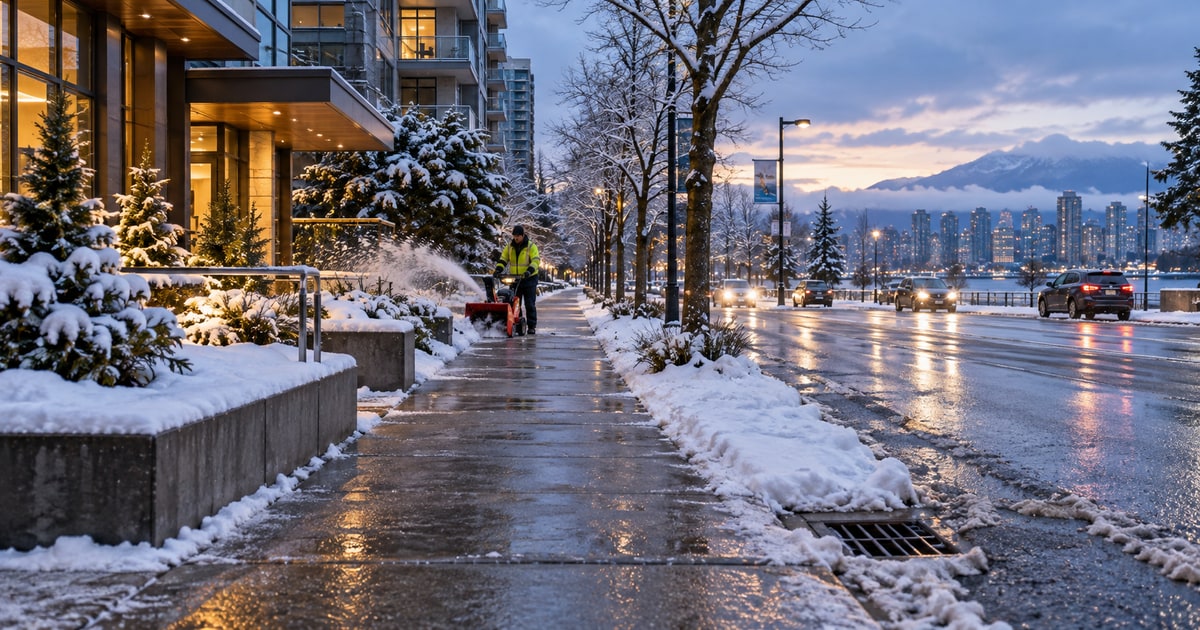
Vancouver snow rarely behaves like dry interior snow. A small accumulation can become heavy slush, blocked drainage and a hard overnight refreeze. For strata councils, commercial owners and property managers, the useful question is not simply whether somebody can arrive with a shovel. The real question is whether the entire pedestrian route can be cleared, treated and checked in the right order.
This guide explains how to build a practical site plan. It complements our main Vancouver snow removal service page with a closer look at sidewalks, entrances, drains, service timing and documentation.
Vancouver's Public-Sidewalk Requirement
The City of Vancouver's winter maintenance guidance says owners and occupants must remove snow and ice from the full width of sidewalks in front of their property, and alongside it on a corner lot, by 10 a.m. each day when snow or freezing conditions are present.
That deadline is one reason a written route matters. A contractor needs to know the full sidewalk frontage, not only the main door. Corner properties, long retail frontages and multi-building strata sites can have much more public sidewalk than is visible from the lobby.
The City's page remains the authoritative source for current requirements. A service agreement should support the owner's compliance plan, not replace the owner's responsibility to understand it.
Start With a Surface Map, Not a Generic Snow Quote
Before winter, divide the property into service zones. A useful Vancouver snow plan normally identifies:
- Public sidewalks along every street frontage
- Main resident, tenant and customer entrances
- Accessible routes, curb ramps and loading access
- Exterior stairs, landings and sloped walkways
- Garbage, recycling and service-room approaches
- Fire-department connections and emergency exits
- Catch basins, trench drains and downspout discharge points
- Approved snow-storage areas that do not block sightlines
This map gives the crew a repeatable route. It also helps the property manager distinguish contracted areas from surfaces maintained by a tenant, neighbouring property or municipal crew.
For larger buildings and multi-unit properties, see our strata snow-removal planning. For shops, offices and mixed-use sites, review commercial snow clearing.
Clear Pedestrian Routes in the Right Order
The order of work matters during a wet Vancouver storm. A sensible sequence is:
- Open a safe route from the public sidewalk to the primary entrance.
- Clear the full public-sidewalk width included in the site plan.
- Open accessible routes, curb transitions and emergency exits.
- Detail stairs, landings, ramps and shaded areas by hand.
- Clear catch basins and drainage paths before moving final snow piles.
- Apply the specified ice-control product where conditions require it.
- Recheck drainage and refreeze areas after the first pass.
This sequence reduces the chance that a cleared entrance is isolated by an uncleared sidewalk, or that melting snow drains across a pedestrian route and freezes again.
Why Vancouver Refreeze Checks Matter
Coastal snow often arrives near the freezing point. Daytime traffic and building heat turn it into water and slush. When temperatures fall, that moisture can freeze on surfaces that looked clear earlier.
High-attention areas include:
- North-facing walkways that receive little sun
- The bottom of ramps and exterior stairs
- Low spots around catch basins
- Canopies and roof-drip lines near entrances
- Compacted areas at loading doors and waste rooms
- Polished concrete, tile and painted parkade approaches
A property with known refreeze points may need a return inspection even when no additional snow has fallen. That requirement should be written into the scope rather than assumed after the first storm.
Keep Catch Basins and Snow Storage Working Together
Snow placement affects the next stage of the storm. A pile beside a blocked catch basin may melt across a sidewalk during the day and refreeze overnight. A pile at a corner can reduce visibility for drivers and pedestrians. Snow pushed against doors, utility rooms or fire equipment creates a new access problem.
The site map should mark acceptable storage zones and areas where snow must never be placed. During a larger accumulation, the plan should also identify whether snow relocation or hauling may be required.
Match Equipment to the Surface
Vancouver sites often combine narrow sidewalks, finished concrete, pavers, ramps and small parking areas. One machine is rarely ideal for every surface.
- A snow blower can move accumulation along longer pedestrian routes without creating a heavy windrow. See our guide to snow blowers for sidewalks.
- Hand tools are still needed at doors, stairs, corners and tight equipment clearances.
- Compact plowing equipment may suit private drive aisles or parking areas when the site has room for safe snow storage.
- Ice-control products should be selected and applied for the actual surface, temperature and property requirements.
The service scope should list the surfaces and expected work, not promise a particular machine regardless of conditions.
Build a Useful Service Record
Documentation is most valuable when it is consistent and tied to the property map. A practical service record can include:
- Date and arrival/departure time
- Weather and observed surface conditions
- Areas cleared and areas treated
- Product used when salting or de-icing is included
- Hazards or blocked areas reported to the manager
- Photos that show the serviced route without exposing private resident information
Records do not guarantee that an incident will never happen. They do help a property manager confirm what was completed, identify recurring trouble spots and improve the next service plan.
Questions to Settle Before Signing a Vancouver Snow Contract
Ask for clear answers to these points:
- Which sidewalks and private surfaces are included?
- What snowfall or ice condition triggers service?
- Is service automatic or requested by the client?
- Are return checks for meltwater and refreeze included?
- Is salting priced separately, and is product included?
- Who authorizes snow relocation when storage fills?
- How are locked gates, parked vehicles and construction zones handled?
- What record does the client receive after each visit?
For dispatch and recordkeeping options, see the PlowWow snow-removal management system.
Vancouver Neighbourhood Conditions Are Not Identical
Downtown and West End properties often have long pedestrian frontages and limited snow-storage space. Mixed-use buildings around Cambie, Broadway and Commercial Drive may combine public sidewalks, loading access and retail entrances. Residential and low-rise strata properties in Kitsilano, Kerrisdale, Marpole and East Vancouver can have stairs, slopes and shaded side yards that refreeze at different times.
The service plan should reflect the actual site. A citywide template is a starting point, not a substitute for measuring the frontage and identifying hazards.
Frequently Asked Questions
When must Vancouver sidewalks be cleared after snow?
The City of Vancouver says owners and occupants must clear snow and ice from the full width of adjacent sidewalks by 10 a.m. each day when snow or freezing conditions are present. Confirm current rules on the City's official winter-maintenance page.
Does a snow-clearing visit automatically include salting?
Not necessarily. Snow clearing and ice control should be listed separately in the quote so the client knows which surfaces are treated, what triggers treatment and whether product is included in the price.
Why clear catch basins during a snow event?
Open drainage helps meltwater leave the site instead of crossing a walkway and refreezing. Catch basins should be identified before snow covers them.
Do Vancouver properties need a return visit after clearing?
Some do. Properties with roof runoff, shaded sidewalks, ramps, stairs or poor drainage may need a refreeze check even without additional snowfall. The requirement should be based on the site and written into the scope.
Request a Site-Specific Vancouver Plan
For a quote based on the actual frontage, entrances, drainage and snow-storage limits, call 604-761-1518 or use the PlowWow quote form. We can price the identified service areas instead of treating every Vancouver property as the same.