
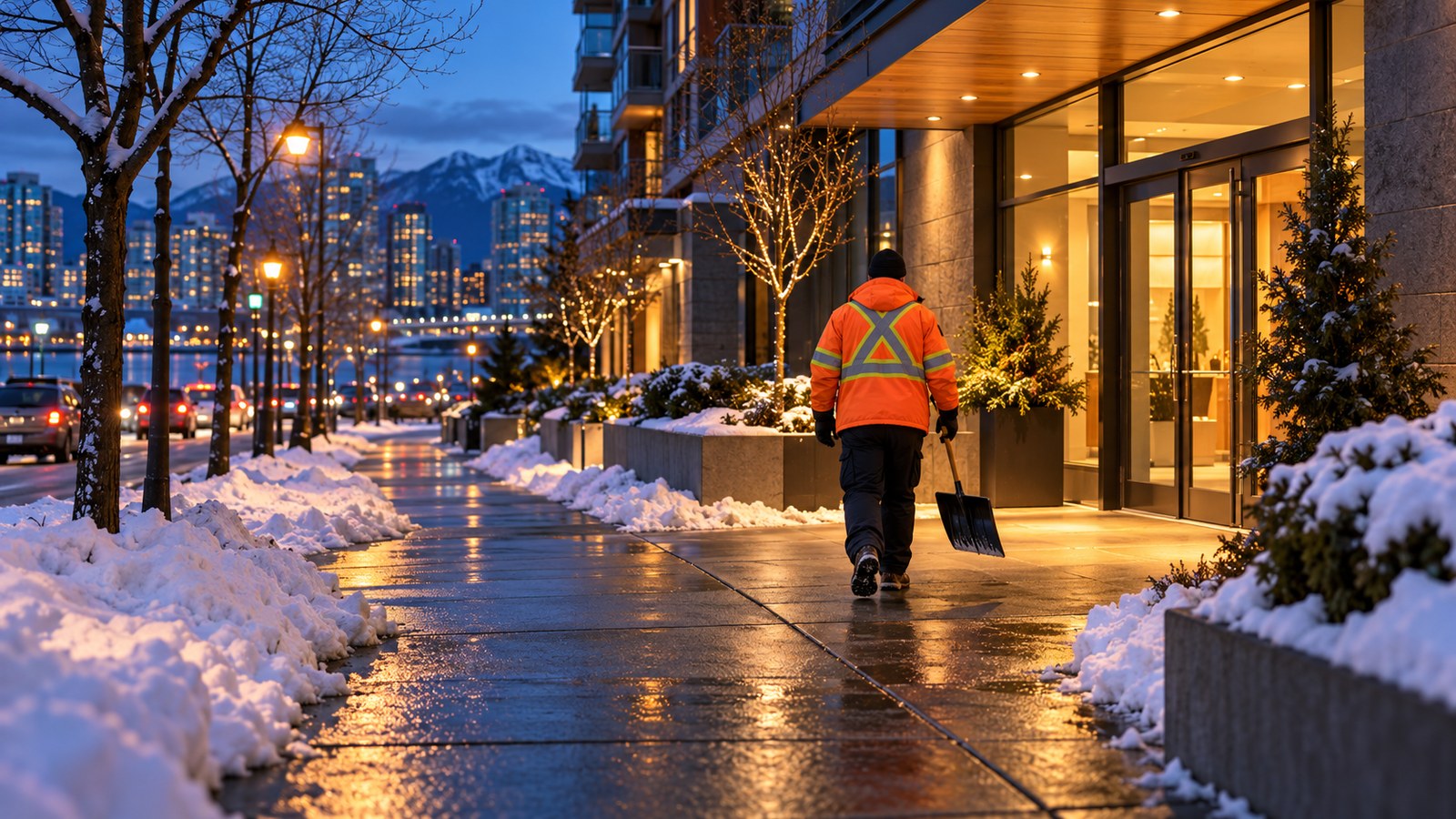
Original AI-assisted editorial illustration of an imagined winter setting. Not a real customer property, weather forecast or completed-work photograph.
By the PlowWow editorial team · October 28, 2026
What the supplied November analysis does—and does not—say
Severe Weather Europe’s October 28 analysis discusses model projections of an unusually early polar-vortex disruption in November. A forecast split or wind reversal is not an observed record and does not establish snowfall at a Lower Mainland address. NOAA’s October ENSO discussion also describes a strengthening El Niño. Treat both as large-scale context; use current local forecasts and site conditions for an operating decision.
A preparation cue, not a city snow forecast
CTV News reported on October 28 that meteorologists are watching a possible early weakening of the polar vortex, with the outcome for Canada unresolved. That is a reason to review winter readiness, not a prediction of a particular storm. This Vancouver guide is an original planning checklist. It does not predict local snowfall, a start date or the severity of this winter.
Start at the property boundary
The City of Vancouver says owners and occupants must clear snow and ice from the full width of adjoining sidewalks by 10 a.m. each day under the conditions described in its winter guidance. Read that guidance for your property, including corner lots. A private service enquiry should identify exactly which adjoining stretches are included.
Connect the sidewalk to the entrance
Walk the route that a resident, customer or delivery worker actually uses. Mark steps, ramps, gates, narrow passages and places where snow cannot be stored. Separate the public sidewalk from private paths and entrances. A clear road beside the building does not tell you whether someone can reach its door.
Give the reviewer a usable access record
Provide the address, a simple marked plan and current photos you are entitled to share. Identify opening hours, a responsible contact and any access restriction. Do not put alarm codes, tenant details or other private information in an initial public enquiry. Ask how sensitive access instructions should be handled.
Define the visit before discussing urgency
Ask whether hand clearing, machine work and treatment are separate tasks, what event or condition triggers attendance, and how return visits are agreed. Confirm that the proposed equipment can reach the intended area. Do not infer site acceptance, a fixed price or a response guarantee from a broad weather headline.
Use a current forecast for the actual decision
ECCC’s seasonal guidance concerns longer-period probabilities, not an address-specific attendance time. Recheck local forecasts and warnings as an event approaches. Ask PlowWow to review the property and confirm scope, availability and commercial terms before relying on a service arrangement.
Discuss the property, confirm the scope
Request a property review or call 604-761-1518. Email wow@plowwow.com. Confirm site-specific availability, scope and terms directly. This guide is not a booking, price quote or promise of attendance.
Snow Intelligence remains first-year beta. This post announces no forecasting, automated dispatch, billing, AR or bylaw-compliance feature.
Sources and checked date
Checked October 28, 2026. Weather reporting and official guidance are linked below; the property-planning checklist is original editorial analysis. No first-hand site inspection or customer outcome is claimed.
- CTV News — Devika Desai, October 28, 2026
- NOAA/NWS — polar-vortex background
- Environment and Climate Change Canada — seasonal forecast guide
- Vancouver official winter guidance
Related planning guides
-
Burnaby: Burnaby strata winter planning: one clear handoff before the weather changes
-
Richmond: Richmond winter planning: keep loading routes and drainage in the same conversation
-
Surrey: Surrey winter readiness: separate the yard, walkway and equipment jobs
-
Severe Weather Europe — original October 28 polar-vortex analysis