Burnaby Snow Equipment: Slopes, Parkades and Commercial Parking
By the PlowWow editorial team · October 4, 2026 · Winter 2026–2027 planning guide
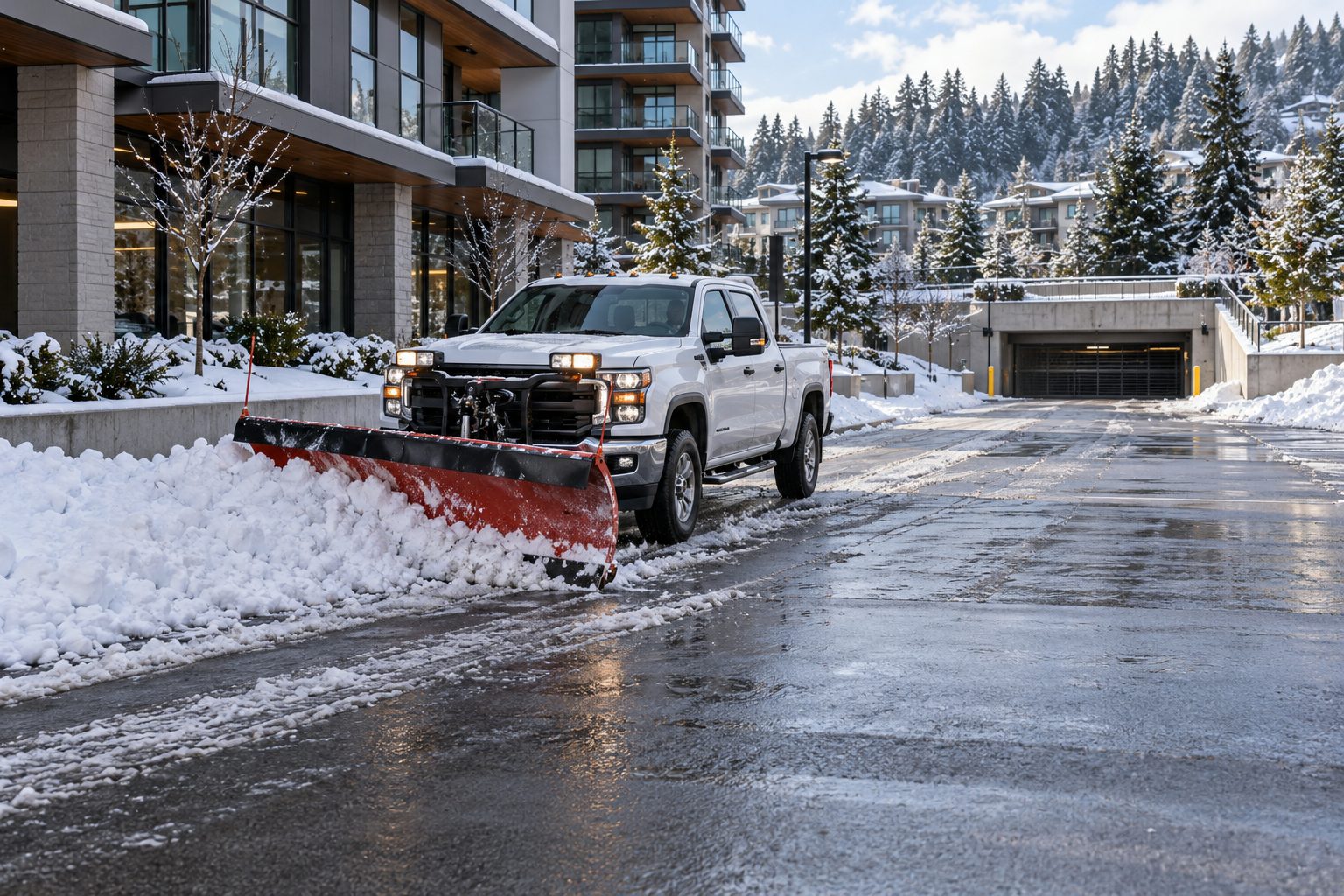
Visual: AI-generated editorial illustration created for PlowWow. The truck is shown in an open ground-level court, separate from the parkade; it does not depict a confirmed Burnaby project.
Which equipment fits this property?
For Burnaby sites with slopes and parkades, access and surface limits come before machine size. Use a site assessment to separate open ground-level plowing from restricted ramps, decks and pedestrian routes. A truck, compact loader and walkway crew may have different roles; no machine category is automatically suitable for an icy grade.
A Burnaby property can combine a relatively open parking lot with a steep approach, a covered entrance and a restricted parkade. Those are different snow-management problems. For winter 2026–2027, a useful equipment proposal explains each zone instead of treating the whole address as one truck-plowing job.
A hillside strata around Capitol Hill or Burnaby Mountain deserves a different access review from a broad commercial lot in Big Bend. Even neighbouring buildings may have different slopes, drainage and operating hours. Select equipment after walking the actual site, not from a city-wide assumption about what machine is “best.”
Separate ground-level work from structural surfaces
First identify what is ordinary ground-supported pavement and what is a suspended parking deck, podium or ramp. A wide entrance does not establish that a surface can carry a loader. Obtain the property's applicable structural restrictions and qualified confirmation of permitted machine and snow-storage loads before equipment is assigned there.
Measure overhead clearance along the whole travel route, including doors, pipes, signs and changes in slope. Record the complete machine dimensions and attachment positions. Do not assume that a truck which fits under the entrance sign has clearance everywhere inside, or that outdoor equipment is suitable for an enclosed area.
This review may leave the truck on the external lot while a separate approved method handles the ramp and entrance. Spell out that division in the contract so a restricted area is not discovered only after the first snowfall.
Compare equipment by the job it can safely reach
- Plow truck: consider it for open ground-level aisles and parking areas with workable turns and a planned snow destination.
- ATV or UTV with approved plow: consider it for sufficiently wide, authorized pedestrian routes after checking surface limits, obstructions and turning space.
- Skid steer or compact loader: consider it for accessible tighter work zones or planned relocation with the correct attachment; compact size does not remove traction or load concerns.
- Front-end loader: consider it where the snow volume, storage arrangement and loading work justify the machine and the site can accommodate it.
Attachment choice matters as much as the machine label. Bobcat's snow blade and pusher guidance distinguishes applications and stresses an approved match to the specific carrier and configuration. A pusher, blade and bucket perform different tasks; ask what the proposed attachment will actually do on your plan.
Make the slope assessment explicit
A heavier machine or tracked carrier is not automatically the right answer on an icy grade. Ask the operator to assess the slope, traction, stopping and turning areas, surface condition and manufacturer limits. Establish when the work method changes or an area needs to be restricted. Do not use an internet slope number as approval for your property.
Check where meltwater from the upper area travels. Clearing a ramp while placing a pile above it may create another inspection and ice-control problem later. Keep drainage paths visible on the winter site map and assign ongoing monitoring, treatment and reporting rather than assuming one clearing pass finishes the job.
Full parking-stall clearing needs access windows
For mixed retail and residential sites around Brentwood or Metrotown, customer turnover and resident parking can make a single all-empty window unrealistic. Agree on phases: priority entrances and aisles first, one vacant group of stalls next, then the remaining released spaces. Identify who communicates with residents and who records an inaccessible stall.
A loader cannot reach beneath cars, around every wheel stop or into every narrow corner. Smaller equipment and hand work may be needed even when a loader handles the larger piles. Define the requested finish, protected features and return-visit arrangement; avoid a vague promise that the entire lot will be bare immediately.
Protect the frontage and confirm the quote
Burnaby's resident and business snow responsibilities require surrounding sidewalks to be cleared by 10 a.m. every day, including holidays. Include the full relevant frontage, accessible connections and entrance timing in the work plan, and check current requirements before winter.
Send your marked layout, slope and clearance information, structural restrictions, occupied hours and storage locations with the quote request. Ask whether relocation or hauling is included, what triggers an extra authorization, and how blocked work is reported.
Use our Burnaby service guide and parkade, hills and opening-time checklist, then request a site-specific plan. For staged resident parking, also read the Coquitlam stall-clearing guide.
Frequently Asked Questions
Can a front-end loader work on a Burnaby parking deck?
Only after qualified confirmation that the structure permits the proposed equipment and snow loads. Entrance width alone does not establish load capacity, and overhead clearance must be checked throughout the route.
Are tracks automatically better than tires on an icy slope?
No. The operator must assess the actual surface, traction, stopping and turning space, attachment and manufacturer limits. A tracked carrier or heavier machine is not automatic approval for a slope.
How should a mixed-use property schedule stall clearing?
Separate priority access from parking cleanup. Arrange vacant stall groups around resident and business activity, assign a communication contact and document blocked spaces for the agreed follow-up.