Langley Commercial Snow Equipment: When Do You Need a Loader?
By the PlowWow editorial team · October 4, 2026 · Winter 2026–2027 planning guide
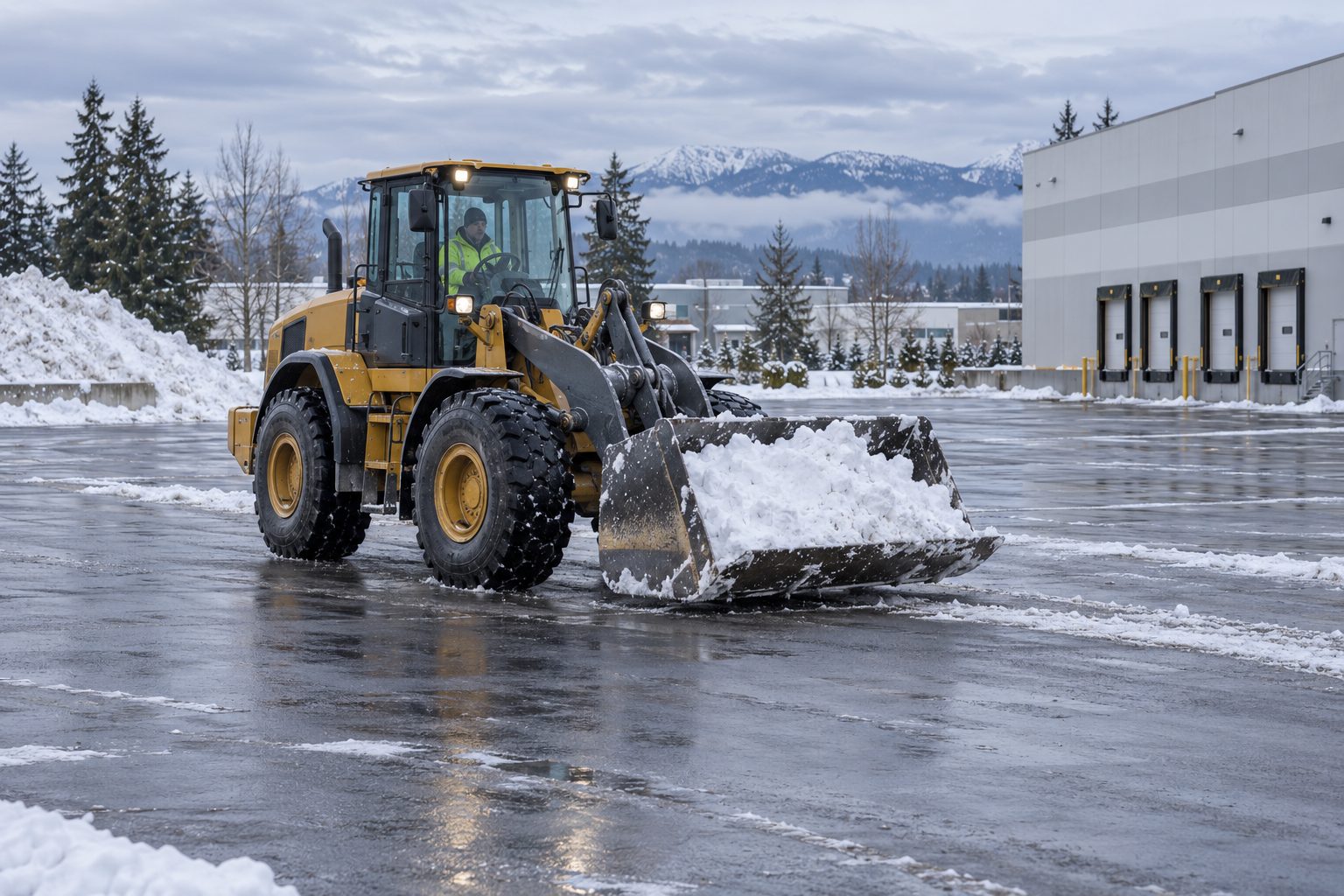
Visual: AI-generated editorial illustration created for PlowWow. The open lot and separate storage area explain a loader's relocation role; this is an imagined setting, not a confirmed Langley customer site.
Which equipment fits this property?
For an open Langley commercial lot, plow trucks may be sufficient when push routes and approved storage work. Consider loader support when snow must be relocated in volume or loaded for hauling. Use compact equipment for suitable tighter zones and a separate walkway plan; lot size alone does not determine the right fleet.
A large Langley parking lot may justify loader support, but its area alone does not settle the question. The useful decision is how much snow must move, how far it must travel, where it can remain and when the property must reopen. For winter 2026–2027, compare complete work plans rather than simply counting trucks and machines.
A retail lot with daytime turnover, an industrial yard with deliveries and a townhouse strata in Willoughby have different constraints. Even a spacious site can have a narrow gate or a loading route that must stay open. Include those restrictions before asking which equipment is best.
When plow trucks may be enough
Truck plows are worth considering where ground-level parking aisles are open, turning space is available and snow can be pushed to approved storage without excessively long or obstructed routes. Ask the contractor to draw the push directions and explain how entrances, islands and loading areas are handled.
Verify the actual truck-and-plow combination rather than treating every pickup as interchangeable. WESTERN's Quick Match application tool is one example of manufacturer-specific matching; the equipment owner should confirm configuration, loading and requirements with the manufacturer or dealer.
For the property manager, the scope matters more than the badge: which areas are included, which require another machine, and what happens after snow occupies the original storage footprint? Compare quotes using the same assumptions about those later visits.
What a front-end loader adds
A loader can be considered for moving accumulated snow within a suitable site or loading haul trucks when off-site removal is arranged. It may also use an approved snow pusher for larger open areas. A pusher contains snow for pushing; a bucket enables a different handling task. Confirm the carrier, attachment and capacity needed for the actual work.
Bobcat describes its snow pusher as retaining snow within the attachment width. That illustrates the function, not a universal recommendation for your property. Machine size, traction, working room and the operator's plan still determine whether that approach fits.
A loader needs an approved route and working area. Identify gates, turning space, overhead restrictions, surface limits, unloading arrangements and any proposed on-site parking for the machine. Do not put a heavy machine or snow stockpile on a suspended slab without qualified confirmation of permitted loads.
Where a skid steer or smaller machine earns its place
Compact equipment may suit a tighter service court, released parking stalls or areas where a larger loader's turning envelope is impractical. It still needs the correct attachment and enough room to work without striking vehicles, curbs or structures. Site-specific inspection is more useful than assuming small equipment can squeeze into any gap.
Broad authorized pedestrian routes can be candidates for ATV or UTV plowing when the full machine and blade fit and the surface permits it. Narrow walks and entrance details may need walk-behind equipment or hand work. Keep that pedestrian scope separate from the large-lot price so it does not become an unplanned extra.
Recovering all parking requires somewhere for the snow to go
If the requirement is to clear all usable stalls, arrange vehicle moves and identify a holding area. A loader cannot clear beneath parked cars, and pushing snow into the last row of stalls does not meet a requirement to recover that row. Use phased access, document obstructions and define any return service.
Mark storage away from doors, fire routes, sightlines and drainage. For a loading yard, also preserve truck turning and dock approaches. Decide when a pile triggers relocation or hauling, who approves it and how loading, transport and lawful disposal are priced. “Loader included” does not necessarily include haul trucks or disposal charges.
Langley City and Township have different rules
Confirm which municipality contains the address. Langley City's snow and ice guidance and the Township of Langley's snow guidance are separate sources. The Township requires daily clearance by 10 a.m. on adjacent sidewalks and walkways for properties zoned industrial, commercial and institutional. Do not automatically apply that zoning-specific rule to every strata or assume it is Langley City's rule.
Have the responsible manager check the applicable current requirements and incorporate the frontage into the service schedule. Mechanical clearing also needs ongoing ice surveillance, treatment and reporting; it is not a promise of permanently bare pavement.
Compare the finished service plan
Send photos, a measured access plan, operating hours, delivery windows, stall-moving arrangements and proposed storage. Ask each bidder to identify equipment roles, scope exclusions, monitoring, documentation and extra-work approvals. This gives a meaningful comparison even when their equipment mixes differ.
See Langley snow-service planning and the strata contract checklist, then send a quote request. Equipment and route availability require confirmation. For the opposite challenge—a constrained urban lot—read our Vancouver sidewalks and parking guide.
Frequently Asked Questions
When is a front-end loader worth considering for a Langley lot?
Consider it when accumulated snow needs larger-volume relocation or loading for hauling and the property has suitable access, working space and load-bearing surfaces. Compare the complete work plan rather than assuming a loader is always required.
Does loader service include taking the snow off site?
Not necessarily. On-site pushing, relocation, loading, haul trucks and lawful disposal are separate tasks. Confirm the included scope, approval trigger and extra charges in writing.
Are sidewalk snow rules the same in Langley City and Township?
No. Check the municipality and property classification for the actual address. The City and Township publish separate requirements, so do not apply a Township commercial-property rule automatically to every Langley strata.